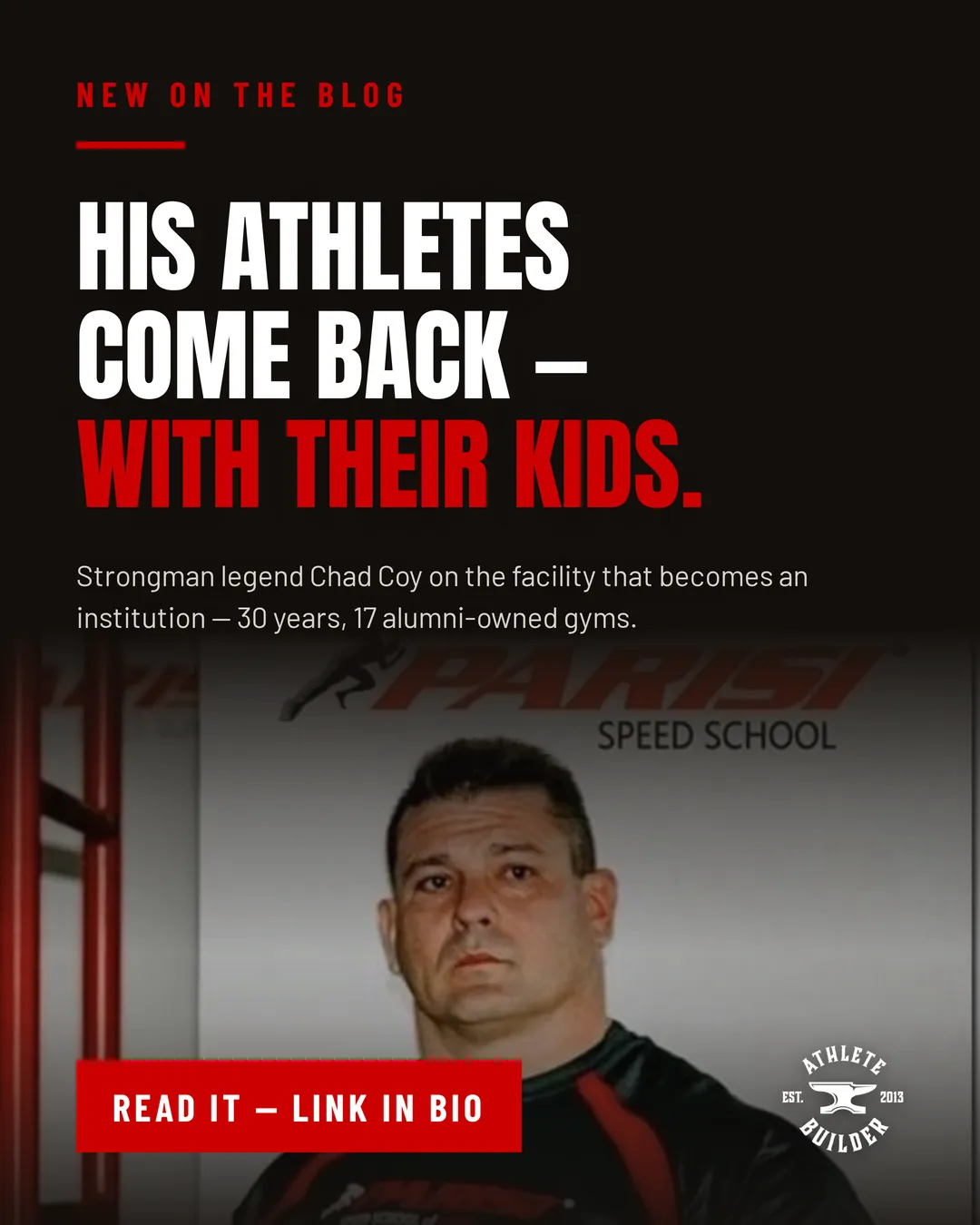
The Gym Athletes Come Back To — With Their Kids
The Gym Athletes Come Back To — With Their Kids
Chad Coy has competed on the World's Strongest Man stage. He holds American and international records in powerlifting. His best meet lifts were a 771 squat, a 420 bench, and a 710 deadlift, and he has squatted 700 pounds every year for more than three decades.
None of that is the number a facility owner should care about most.
This is: by his own count, roughly 300 of his athletes went on to play college sports, 25 became professionals — and seventeen of his former athletes and coaches now own their own facilities. He opened his first gym in 1995, bought the 13th Parisi Speed School franchise in 2006, and spent thirty years turning a training business into an institution. On Episode 48 of the Athlete Builder podcast, he laid out how — and almost everything he said is a playbook an owner can run.
The product isn't speed — it's confidence
Coy is a master coach for a company whose name is literally about speed, and here's how he describes it: "I always laugh because I always thought the name should be the Parisi School of Self-Confidence and Self-Esteem. But kids wouldn't get excited about that. What kids get excited about is speed."
That's the sharpest positioning lesson in the episode. Market the outcome families can see and want; deliver the deeper product that keeps them for a decade. And the deliverable is teachable: "Speed's a skill. So we teach it as a skill, just like strength is a skill, just like agility is a skill... and you can hone that skill and become better."
The culture is codified the same way. Every family that walks through the door hears the same four pillars: "respect, coachability, work ethic, and effort. That's what the athlete can master. If you do those things, you're going to be successful in life." Notice what that is from a business standpoint — a product definition. Not vibes. Four words a parent can repeat at the dinner table, and a standard every coach on staff can hold.
Retention isn't a funnel — it's love with a system
Ask Coy for his coaching philosophy and you get something most marketing consultants would never write down: "You get those kids in that classroom for one hour and you make it the best damn hour of their whole day — because you don't know what they've got at home... You give them a hug and you say, I believe in you. I'm proud of you. Those words go so far. And when a kid sees that, there's not a damn thing they won't do for you."
Soft? Look at the balance-sheet version. The kids Coy trained in Kokomo in the 1990s started bringing him their own children fifteen and twenty years later — "because they know exactly what they're going to get." That last phrase is the whole retention model. Consistency as brand. Predictability as moat. He tracks his own: since November 1, 1982, he has missed 27 workouts. Total. When someone asks him the most important factor, the answer is one word: "Consistency in everything you do."
Most owners measure lifetime value in months. Coy's facility measured it in generations.
The bigger-stick playbook
Here's the section every private facility owner should read twice, because most of us get the school relationship wrong. The default posture is rivalry — the school program and the private gym fighting over the same athlete. Coy's posture is the opposite, and it starts with a rule he gives every family: "Your team workout comes first. This is the extra mile. You have to be on the first mile. If you're not on your team's mile, it really doesn't matter what you're doing the extra mile."
Then he walks into the school and says the line that should be framed in every owner's office: "I don't want to steal your thunder — I want to give you a bigger stick."
And he means it operationally. He has certified a dozen high-school coaches on his system — his software, his training, his methods. "That makes their life easier. That's the number one thing. I look at: how can I make your life easier?" His scoreboard for the arrangement: "There's always a way to make it a win-win for everyone... a win for you, a win for the outside party, and most importantly, a win for the kid. But I'll take two wins over three — the school and the kid."
Think about what that does to your pipeline. The facility that certifies and equips school coaches stops fighting for athletes and starts receiving them — with the coach's blessing, which is the only referral in youth sports that actually converts.
The operator's P&L for knowledge
Coy has two degrees and roughly thirty certifications — he adds one every year, and has for decades. He pays a nutrition coach to mentor him. He pays for his own programming. His picture of expertise: "There's an iceberg of training knowledge, and 10 percent is floating above the water and 90 percent is below the water. I'm a few degrees below the water." And his filter for every method war in this industry, borrowed from Louie Simmons: "Everything works until it doesn't."
That's a line item most owners never budget: structured, paid learning, every year, forever. The ones who stop learning become the coaches Coy has no patience for — the ones who can make a kid tired but can't make him better.
And the money doctrine that ties it together — both halves of it, because he says both: "If you're in it for the money, there's way better places to make money. I'm in it to make a difference. And if you do make a true difference and you care for people and you actually love people, the money's gonna take care of itself." But he's no romantic about the model: "In the private sector, if you're not making money, you're out of business." Mission funds margin. Margin funds mission. You need both hands on the bar.
If you own a facility
Everything above runs on one discipline: diagnose before you prescribe — the athlete's weak link, the school's missing capability, your own knowledge gap. It's the same reason our free Athlete Builder Scorecard(athlete-builder.com/assessmenttest) scores an athlete across six blocks before anyone touches a program: the diagnosis is the credibility.
If you want to talk through the operator side — the retention system, the school playbook, the machine behind a facility that lasts thirty years — book a Game Plan Session: link.closersoftware.com/widget/bookings/ab-gameplansession.
Or answer me this one: what's your relationship with your local schools right now — partner, stranger, or rival? Hit reply and tell me. I read every one.
Win the Day. Stay Relentless.
