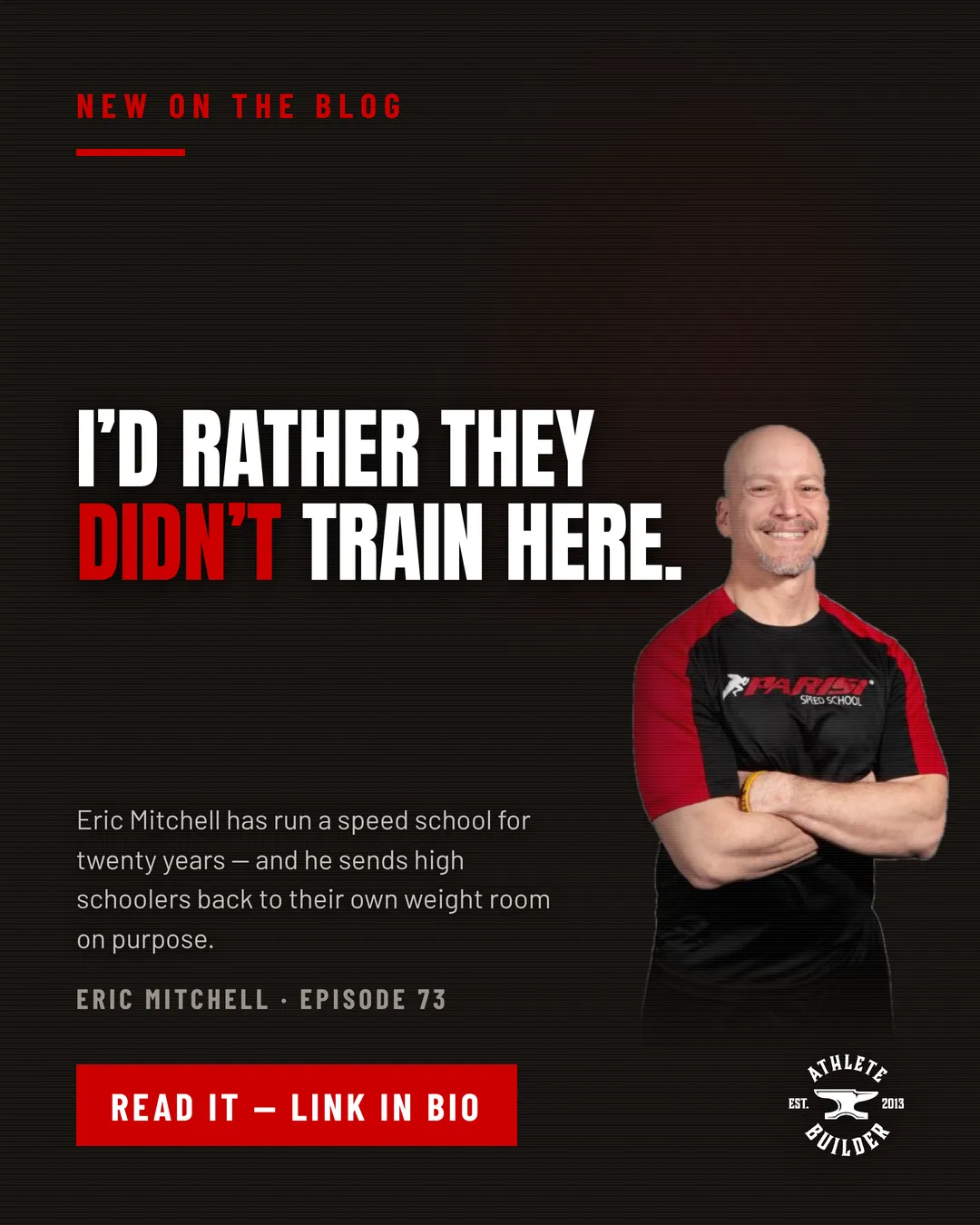
Why This Gym Owner Turns High Schoolers Away
Why This Gym Owner Turns High Schoolers Away
A high school junior walks into your facility with a parent who already has the card out. Three days a week, twelve weeks, paid up front. You have the space. You have the slot.
Eric Mitchell tells a lot of those families no.
He has been in the Parisi Speed School system since 2005 — he bought the third franchise in the country — and he has spent twenty years building exactly the kind of youth performance business most owners are trying to build. He has also spent twenty years refusing a specific kind of revenue on purpose. Because the money he turns down buys him something the money he takes never could.
Here is the posture, in his own words on Episode 73:
"We're an adjunct to what you guys do. That's what we are."
Read that again if you own a facility in a town with a high school that has a weight room.
"I'd rather them not be in our strength training program"
Most private facility owners treat the local high school strength coach as the competition. He has the athletes. He has them for free. He has them at 6:45 in the morning before you have unlocked your door. So the default play is to go around him — recruit the kid, work the parent, position your program as the real one.
Mitchell does the opposite, and he says it out loud:
"The high school kids, I would rather them not be in our strength training program if they're in a really good strength training program at school."
That is a facility owner declining high school strength revenue — the most reliable recurring revenue in the building — because somebody else is already doing that job well.
What he keeps is the part nobody else is doing:
"Our elementary kids, sure. Our middle school kids, absolutely. Because at least they're learning the fundamentals with us. So when they get to you, they're looking at you, you're like, wow, this kid really knows how to deadlift. This kid knows how to squat. This kid knows how to bench."
Look at what that actually is. He is not giving away market share. He is farming it. Every middle schooler he hands off arrives in that high school program coachable, and the high school coach knows exactly where the kid came from. That coach now has a reason to send families back the other direction — for acceleration, for change of direction, for the work the school day has no room for.
"Guys, I'm not here to do your job. That's not my job. My job is very, very different."
And on owners who play it the other way:
"If anybody has a speed school in some community and they cause friction, that's a real serious ego problem... You have a coaching culture here. You want to make sure you're cooperative. You don't want it to be where you're pushing against the very nature of the foundation they're trying to build in the school."
The territory math is not complicated. There is one of you and there are a dozen schools. You can spend a decade competing with twelve strength coaches for the same athletes, or you can spend a decade being the person twelve strength coaches recommend. Only one of those compounds.
The rule of 166
The second thing Mitchell does is set the ceiling before anybody pays him. He has a name for it.
"We call it the rule of 166, because when we got the kids for two hours... how many hours are in a week?... it's 168. If they're with us for two hours, they got 166 more hours to work on something during the week to make themselves better. That's it."
Two hours out of 168. About one percent of an athlete's week.
Most facilities sell the opposite message. The brochure implies the two hours are the transformation. Then the athlete does not sleep, does not eat, plays through three club seasons, and at week ten the parent decides the program did not work.
Mitchell hands them the math on day one. It reframes the entire relationship: the sessions are the instruction, the other 166 hours are the execution, and the family owns those. Jim's version of the same idea, from the same conversation:
"It's not how hard can you train. How hard can you train, recover, and then train hard again?"
There is a retention argument buried in here that owners consistently miss. The families who churn out at week ten are almost never the ones who were told the truth about the 166 hours. They are the ones who were sold the two.
"You don't want to take our money"
Mitchell is far enough along that he will disqualify a family inside the consult — the parent who wants to buy once a week, stacked on top of two field hockey teams, a soccer team, gymnastics and weekend swimming.
"I actually had a parent that, you'll love this one. They go, they're like, you don't wanna take our money. I said, no, I didn't say that. You said that. Of course I want it. I'm a for-profit business. I want to take your money. But I'm not gonna do it if it's not gonna be beneficial for your child."
That is the cleanest disqualification script you will hear from an operator. It does three things at once: it refuses the sale, it refuses the guilt, and it tells the parent exactly what the standard is — without ever once pretending the business is a charity.
It is also the only honest way to run a guarantee. Jim ran one for years on the adult side of his gym: average three days a week, retest at three months, get better or get the money back. He never paid one out. The reason is not that the program was magic. It is that the guarantee was bolted to a dose the athlete actually had to hit, and he turned away the people who were not going to hit it.
If your close rate is ninety percent, that is not a strong offer. That is a missing filter.
Two kinds of kids walk through your door
Mitchell says he can pick out the athletes who are going to get results before they have done a single rep — not from testing them, but from watching who answers the question.
"You'll know that kid, the kid that's leaning forward and listening to everything I say about their technique and focusing on everything. And when you look at them and say, is this a program you feel is going to work for you? Their parent doesn't answer. They answer. Yes, I want to do this."
And the blunt version:
"There's two kinds of kids. The kids that are, their parents are dragging them in the door, and then there are kids that are sprinting through the door to get into your facility. That's the difference."
He is not saying refuse the dragged kid. He is saying know which one you signed, staff the effort accordingly, and stop being surprised when the two produce different outcomes on the same program.
On what separates the athletes who keep climbing from the ones who stall at good:
"Good athletes kind of just do what they're supposed to do. That's what they do. The great ones will do more than anybody else is willing to do."
And the frame he uses to get a fourteen-year-old to accept being bad at something in public:
"Could you write a story without knowing the alphabet?... If you don't learn the fundamentals, all the fundamentals, that's the alphabet of training. You can't form words, you can't form sentences, no paragraphs, then there's no story."
Being right is not the same as getting through
Mitchell is pointing the next stage of his business at coaches rather than athletes.
"I like to coach coaches."
He is also honest about what it took to get there. We have, he says, "an entire generation [of] kids that overplay a sport and undertrain their bodies." He has handed parents the data and the durability argument, and watched them walk out to find somebody who would tell them what they wanted to hear.
Which is exactly where Jim put the real problem for owners:
"Even if we're all right about what we're saying, if we can't reach them, we have no product, we have no service, because we're not coaching anybody."
Being right about training is table stakes. The business gets built on the part in front of that: the posture that turns the local strength coach into a referral source instead of a rival, the math that sets expectations before the card is run, and the willingness to turn away the family you cannot actually help.
Mitchell's favorite quote, from Chuck Noll:
"Great players don't do anything extraordinary. They just do the ordinary better than everybody else."
Same is true of the buildings they train in.
CTA
If your relationship with the schools in your area is a standoff instead of a pipeline, that is a fixable problem — and it is usually the highest-leverage one in the building. Book a Game Plan Session and we will map where your referrals should actually be coming from.
Watch the full conversation with Eric Mitchell — Episode 73:
Win the Day. Stay Relentless.
