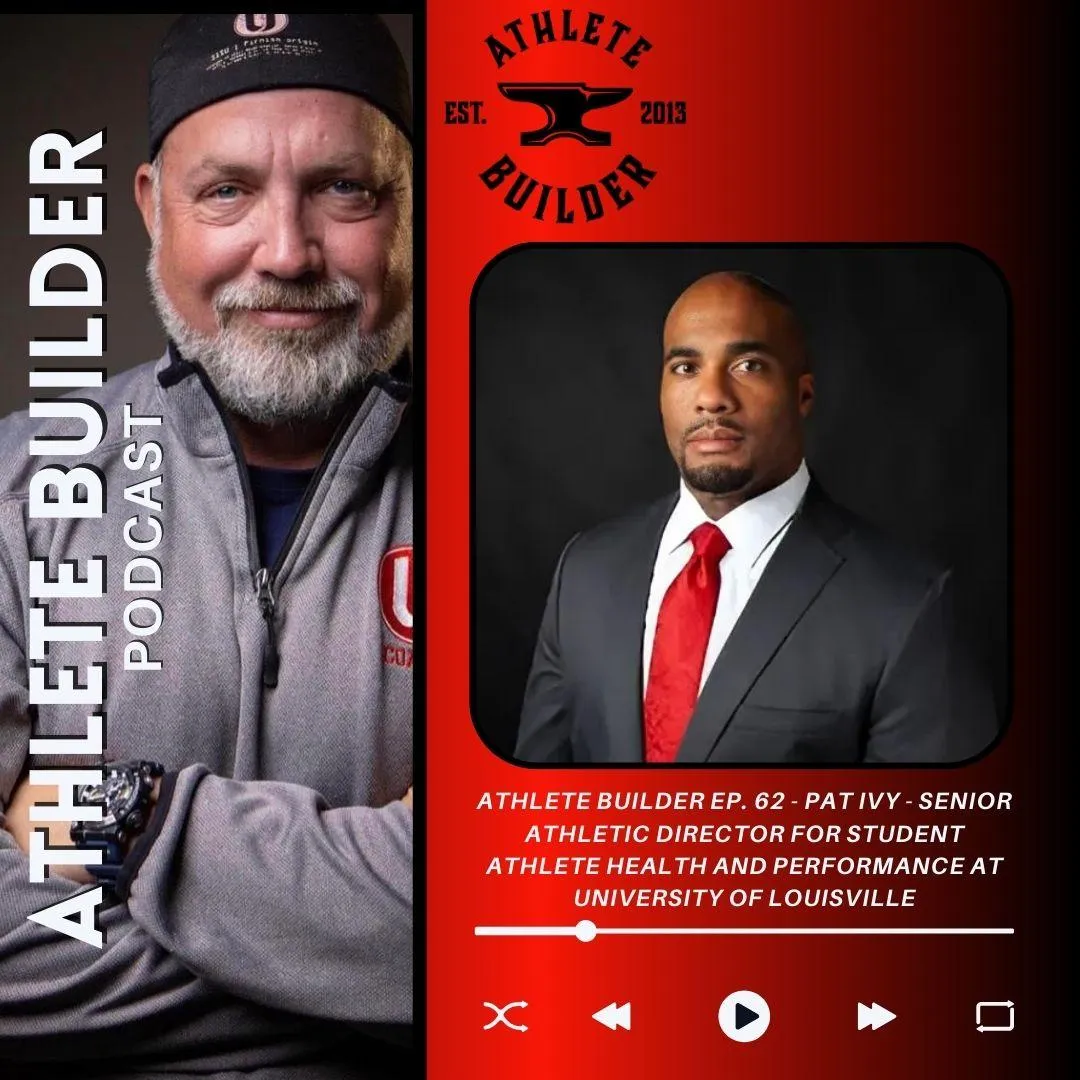
He Chased Every Edge for 20 Years. One Was Missing
He Chased Every Edge for 20 Years. One Was Missing
Pat Ivey was an undrafted rookie at his second Chargers minicamp when he saw the thing that changed his career.
He watched Junior Seau on the sideline — the loudest, funniest man on the field, cracking jokes between series. Then the ones got called back onto the field, the chinstrap buckled, and Ivey watched a switch flip in an instant. "From funny, hilarious to serious. Assassin."
And then he did the thing most 22-year-olds never do. He turned the observation on himself: "I've got a dimmer switch that turns up slow... If I'm going to make it, I better get me a switch and get rid of this dimmer. Because by the time I turn it up — I won't make it here. I'm too slow."
He went back to Missouri with four weeks before training camp and one job: turn a dimmer into an on/off switch. Not a bigger bench. Not a faster forty. A mental skill.
Keep that story in your pocket, because the rest of this conversation explains why it matters for the athlete in your house.
Who's saying this
Pat Ivey played on the defensive line at Missouri and spent four years in the NFL. When football ended, he went to work: master's degree, PhD, more than twenty years building athletes. Today he's the Senior Associate AD for Health & Performance at Louisville Athletics, where sports performance, sports medicine, sports nutrition, sports science, mental health, and mental performance all run through his office.
When someone with that resume tells you where the real edge is, you listen.
Twenty years of chasing the edge
On the podcast, Ivey walked me through the entire arc of modern athlete development — because he lived every phase of it as a coach.
First it was fueling: athletes cramping, athletes who needed to gain weight. Then mobility became the thing. Then explosiveness and rate of force development. Then the discovery on the other side of it: "We have not focused on absorption. Now we got athletes that jump, they can't land." Then correctives. Then keeping the best players on the field, because "the best ability is availability." Then sport science — bar speed, GPS, player load. He got so deep into it he was standing in cadaver labs with orthopedic surgeons, learning joints from the inside.
Two decades of stacking every physical edge that exists. And still: "We're missing something."
Then the sentence that should stop every sports parent cold:
"We worked in reverse of how we should have. We finished up with the mind and learning about it. Maybe we should have started there — because everything starts with the thought. Your thoughts affect your emotions, your emotions affect your actions."
And your actions produce your results. The block that drives everything got built last — by one of the most credentialed performance minds in college sports. If it took him twenty years and a doctorate to get there, imagine how many athletes are grinding away right now at the wrong block.
Focus is a skill — not a personality trait
Here's the part of the conversation I want every parent to hear. Coaches scream about focus and mental toughness constantly. Almost none of them teach it, because almost none of them were taught it. Ivey remembers the exact moment the lightbulb went on for his staff: "You mean you can teach mental skills that apply in sport?... Focus is a skill. A choice and a skill."
Read that again. A skill. Like a squat pattern or a route tree. Which means it can be coached, drilled, and built — and it means "my kid just isn't focused" is a diagnosis of the training, not the kid.
Ivey didn't leave it as theory. He installed it as a habit. Every lift and every practice at his programs opened with a call-and-response. He'd yell, "Where are you?" The whole room answered: "Right here, right now." Then one word — focus — and the work started. His reasoning is as simple as it gets: "Performance happens in the now. And if you're here to deliver a great performance, then it happens in the present moment."
That habit is free. Your athlete can install it this weekend: pick the trigger moment — walking into the gym, stepping in the box, lining up — ask the question, give the answer, go to work.
The name on the back of the jersey
Ivey's doctoral dissertation asked the question every coach and parent wants answered: what do the elite have that everyone else doesn't? He interviewed Pro Bowlers, Super Bowl players, NFL starters and top draft picks — men he had personally coached.
The finding: "The best of the best do it for the names on the back of their jerseys."
Their family name. Their own name. Who they are and who they represent. Not the doubters, not the highlight reel, not proving somebody wrong. Ivey knows that last one firsthand — proving people wrong got him to the NFL, and then the fuel ran out: "That was good enough to help me get there, but not stay."
He watched the lesson play out on a conference stage, too. A coach finished a presentation preaching "big team, little me" — it's only ever about the name on the front. Nick Saban walked on next and said the opposite: "It's about the individual" — about making sure every player has what he needs to become the best person and player he can be, so the team you assemble is a team of maximized individuals. Saban went on to keep winning national championships.
For your athlete, the takeaway is identity. Motivation built on external noise burns out. Motivation built on who I am and who I'm doing this for — that one compounds.
One more gift: FASTER
Ivey needed a nutrition framework his athletes could remember without notes, so his staff built an acronym they've used for years — FASTER. F: fill up with fruits and vegetables. A: always hydrate. S: start with breakfast — break the fast, even if it's a banana before a 6 a.m. lift. T: think lean protein. E: eat often. R: rest and recover. Then his bonus letter: repeat.
No supplements, no extremes — just the basics, made memorable. (For weight or body-composition goals, especially with a young athlete, work with a registered dietitian.)
Find your athlete's missing block
Pat Ivey is one of the smartest people in athlete development, and it still took him twenty years to find the block he'd skipped. Your athlete doesn't have twenty years.
Every athlete is built from six blocks — three in the head (Mindset, Knowledge, Teammates) and three in the body (Training, Nutrition, Recovery). Most families pour every dollar and weekend into the body and hope the head sorts itself out. TheAthlete Builder Scorecardscores all six in about ten minutes and shows you the weak block — the one quietly capping everything else. It's free: athlete-builder.com/assessmenttest.
Start where Ivey wishes he had.
Win the Day. Stay Relentless.
