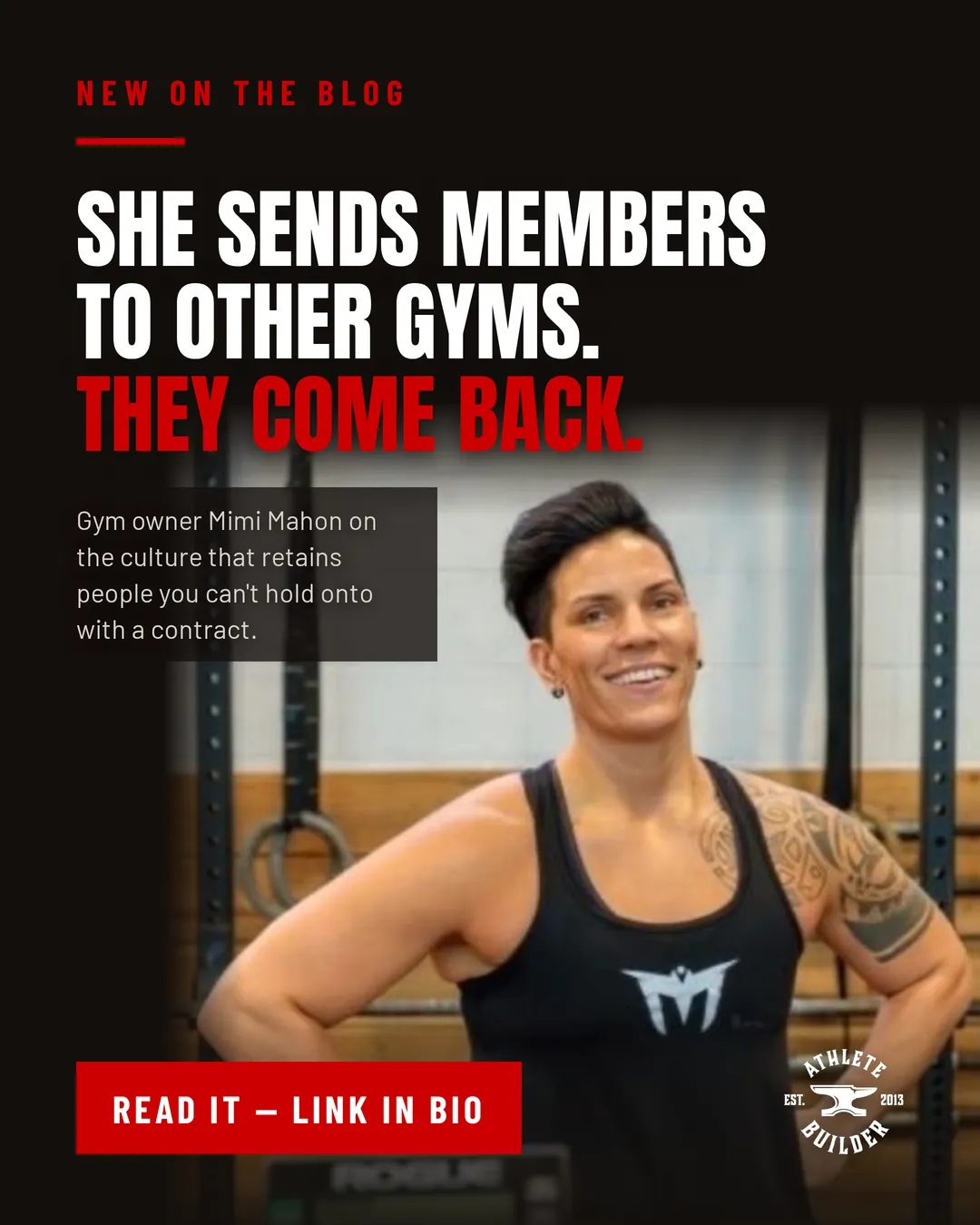
She Sends Members to Other Gyms. They Come Back.
She Sends Members to Other Gyms. They Come Back.
Most gym owners treat a cancellation like a breakup. The member leaves, the owner takes it personally, and somewhere in the exit conversation a competitor gets called a joke.
Mimi Mahon does the opposite. When a prospect walks into Mahon Strength & Fitness and wants something her gym doesn't do, she tells them where to find it:
"Hey, there's, you know, so and so CrossFit down the street that probably trains in a way that sounds like that's what you're looking for."
And when members leave for a place closer to home? "They actually ended up coming back to our gym because I didn't get upset with them for leaving."
That is a retention strategy most owners would call crazy. On Episode 44 of the Athlete Builder podcast, Mimi explained why it works — and it starts with knowing exactly what you sell.
Some context on who's talking. Mimi played college softball on a torn ACL at the end of high school, worked her way from an NAIA program to Division I at Cleveland State, became a head college coach at 23, and later coached and ran strength and conditioning at the college level while training clients on the side. She trained at my gym for a stretch — driving 45 minutes each way to do it. Then she built her own.
Name the program after the coach
When Mimi opened her facility, she chose the name on purpose. Not a methodology. Not a franchise category. Her own name.
"I purposely called it Mahon Strength and Fitness. And that is because it's Mimi Mahon's program and it's okay if it doesn't align with what you want."
Read that last clause twice, because it's the whole business. She refuses to put her gym in a box — "I can't just be a powerlifting gym, a bodybuilding gym, a CrossFit gym" — so the product is her judgment applied to each member's goals. The name tells the market what it's buying.
That clarity is what lets her refer out without fear. An owner who isn't sure what they sell treats every departure as a threat. An owner who knows exactly what they sell can tell a bad-fit prospect where to go — and look more credible for doing it.
The confession every owner needs to make
Mimi's path to that clarity ran through a mistake she's still willing to name out loud. As a young head coach, fresh off falling in love with CrossFit, she ran her softball team through the same workouts she was doing herself: "Thrusters, burpee over the bar. One of my athletes kind of like hurt her wrist on a clean."
Her diagnosis, looking back: "I didn't know better at the time to say like, it's not about what's best for me... It's what's best for these young ladies in front of me and what they need to be better softball players."
Her mantra now is if you know better, do better — and she built it straight into her programming. Adult members train for life. Athletes train for their sport. Parents ask all the time whether their kid can just drop into the adult class, and her answer is a flat no: "Johnny needs to be training for his sport, not just like overall fitness and strength."
Separate products for separate outcomes is not a scheduling detail. It's the difference between a gym and a training business.
Game day, not a workout
Here's the part that should make every owner rethink their class structure. When Mimi was training clients in Boston, they told her something she hadn't planned: "When we come to your classes, it's like game day. We feel like it's game day and we feel like you're the coach."
So when she opened her own gym, she called the adult classes team training — and built the culture around a line worth stealing: "Me with you, me for you, me in support of you, not me against you."
Her read on adults is sharper than most coaching certifications teach. They don't need to be yelled at. "They need to be supported and given like just basically like tangible goals." They arrive carrying jobs, kids and stress, and they come to the gym to be removed from all of it.
And recognition has to be distributed, not concentrated: "Don't just praise the person that's lifting 300 pounds... that person over there that's pulling a 205, that's the first time they've done that. They're excited too."
She runs it on measurement. Every month the gym tests a strength piece and a conditioning piece and retests on a cycle. Four weeks isn't a full training block and she knows it — the point is the signal. "It just gives people that little carrot to chase."
That's the same principle behind the freeAthlete Builder Scorecard(athlete-builder.com/assessmenttest): people stay where they can see themselves getting better. Measure it, and you have a retention system. Skip it, and you have hope.
Price like you believe it
On pricing, Mimi doesn't flinch at the $10 gym down the road: "That is fine. There's a place for that. We are professional certified trainers and we're going to give you the individual attention that we think you need."
Her framing: charging real money is "totally about feeling proud of what you have to offer." That's the same posture I bring to my own intake conversations. I don't think of it as selling. I ask enough questions to find the real reason someone walked in, and if I can solve that problem, I simply ask whether they're ready to get started. If I can't solve it, there's no reason anyone should move forward.
Two operator habits round out her model. When the pandemic shut gyms down, she loaded her trunk with barbells, bumper plates and a sled, trained people in parks and backyards and on Zoom — and her business grew while others shrank. And she built a compensation plan that pays her coaches to keep learning, because "being stagnant is so scary."
The deposit that changed her
There's one more reason Mimi builds a culture that gives first. When her mom needed a kidney transplant and Mimi wasn't a direct match, she pushed the hospital to enter her in a paired exchange: Mimi donated to a stranger, and her mom received a kidney from someone else. She's since competed in the Living Donor Games and helped run a regional event.
Her conclusion from all of it is the operating philosophy of her gym: "The sooner that people can realize it's actually not about you and it's what you can do for others. And that will actually enhance your life in return."
She puts the same idea more bluntly: "You can either be an energy giver or an energy sucker. And there's nothing in between." Members feel which one you are within a week.
If you own a facility
Mimi's gym motto doubles as a vision: MSF stands for Mahon Strength & Fitness — and for making strong families. The owners who build that kind of loyalty are the ones who never have to talk anyone into staying.
If you want to compare notes on the machine behind a facility like that — the intake, the measurement, the culture that brings people back — book a Game Plan Session: link.closersoftware.com/widget/bookings/ab-gameplansession.
Or answer this one: when was the last time you referred a prospect to a competitor? Hit reply and tell me. I read every one.
Win the Day. Stay Relentless.
