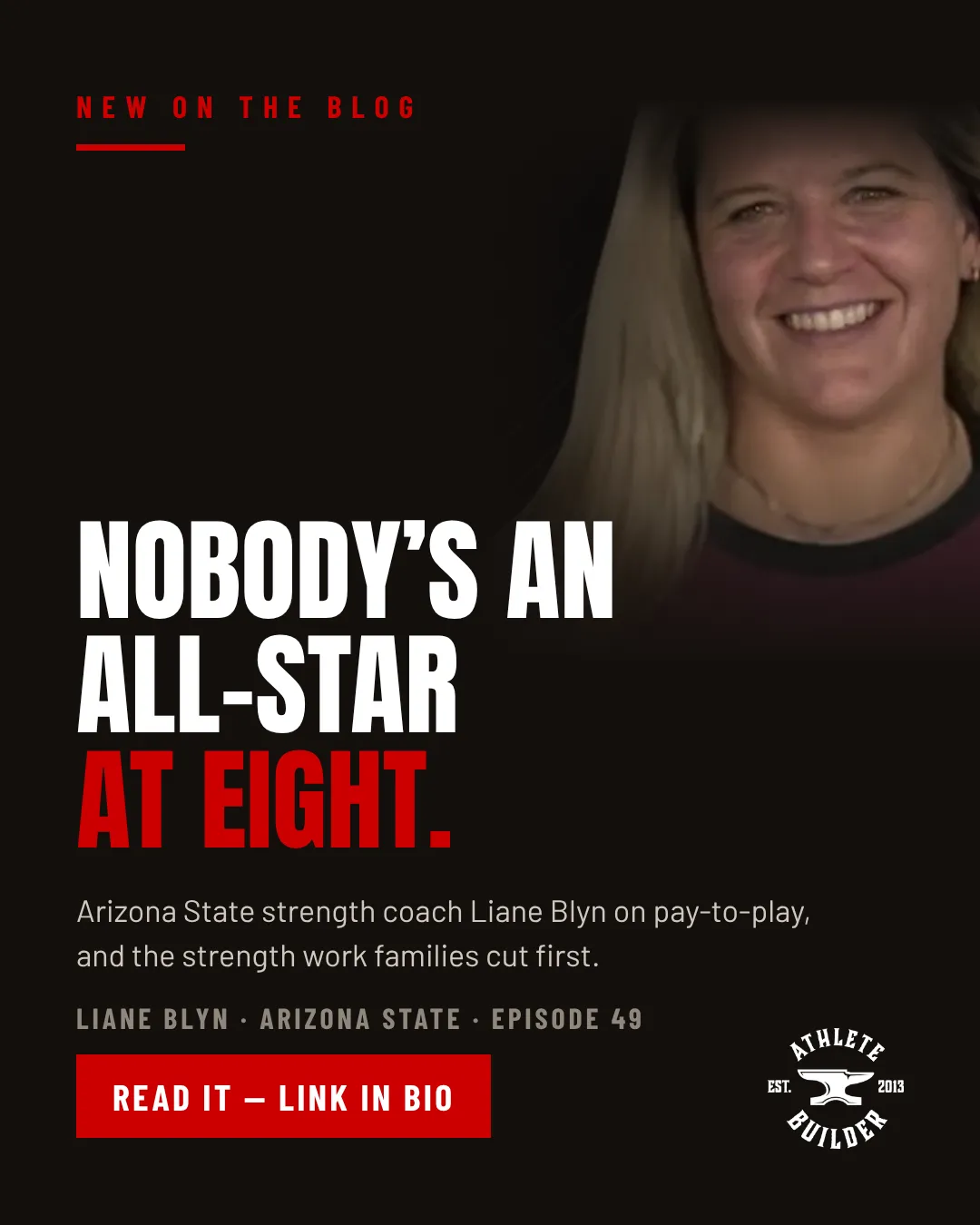
Nobody's an All-Star at Eight
Nobody's an All-Star at Eight
A parent once walked into Liane Blyn's gym with an eight-year-old and told her the kid was going to be the next Tiger Woods. They wanted one-on-one, sport-specific training.
She said no.
Not because she didn't want the business. Because an eight-year-old doesn't need a private performance coach. He needs to play. Her youngest group did "fun games, go have fun, like learn how to move, learn how to compete." Weights came later, in stages, as the athlete was ready.
Liane has been in strength and conditioning for 28 years. When we recorded, she was the strength coach for Arizona State, with men's hockey as her main team. She was also one of the best powerlifters in the world for two decades: top three at every world championship she entered after her first one, and a 424-pound bench at about five foot three. She once pulled a 14,000-pound plane.
She's also thankfully blunt, and parents need to hear what she said.
You're being sold a pipe dream
Liane doesn't hold back on youth sports:
"anyone can pay to play. It's all about money. Parents are being sucked in."
Kids get told they're the next Connor McDavid or Tom Brady. "You're being sold a pipe dream." Parents only see the finished product on Sunday or Monday night. They don't see what it took to get there.
And she has no patience for the trophies: when AAU and club ball meant something, "you were the best of the best." Now leagues name eight-year-old all-stars. Nobody's an all-star at eight.
Her numbers are sobering. She said about 75% of kids drop out of organized sports by high school, a small percentage play in college, and roughly "one in 300,000 make it to the professional level." Every parent thinks their kid is the one. Her question is the right one: "are they doing the right things? Are they training? Are they eating? Are they sleeping?"
Available and durable
Here's the line I want every sports parent to remember. It's how Liane describes her whole job:
"Availability, I need to make those kids available to coaches and I need to make them durable."
Coaches want kids who are healthy enough to play and tough enough to make it through the season. That's what strength work is for.
And it's the first thing families cut. "Little Johnny's got to go to this practice and that practice," she said, and then parents decide there's no time for strength and conditioning. "He doesn't need that. No, that's a big piece of the puzzle that you're not developing your kid."
Her comparison is a house. Skip the foundation and it doesn't matter how nice the walls are. "If you don't build a solid foundation, your body's going to crumble." A kid can be the best on the field at ten and break down by fifteen.
Nothing guarantees an athlete stays healthy. But a strong, well-prepared body handles a long season better than a weak one. I've seen it for years: everyone on a team can tell you which kid is going to get pushed around.
Ask who's running the weight room
Liane said something I've started repeating to every parent I talk to:
"You wouldn't put a pool in without hiring a lifeguard."
So why would a school put in a weight room without a qualified strength coach?
Parents, ask the question. Who writes the program? Who's on the floor coaching it? If the answer is nobody, or whoever's free that day, your athlete's training is a gamble.
When Liane ran her own training business, she had a rule most facilities won't make: "I would never allow an athlete to miss his training with his team ever." If an athlete wanted extra work, she'd coordinate with his school's strength coach. A lot of places, she said, are just "rolling kids in and out." Look for the coach who sends your kid back to his team.
Connection, communication, collaboration
Before a recruit ever arrives at Arizona State, Liane calls him. She asks how he's trained, who he's worked with, what he likes and doesn't like.
Her approach comes down to three words: connection, communication, collaboration. And she breaks it down like this: "Connection is what I want for you. Communication is what I want from you."
Then: "If you have no connection with that student athlete, you'll never be able to tell them what to do and they will never respect your opinion or your expertise ever."
That's true for coaches. It's just as true at your kitchen table.
Let them choose
The hardest story Liane told me was about two sisters who both played softball. The older one was the valedictorian of her class and could have gone almost anywhere for school. She went to a small school for softball, because her dad wanted to say his daughter played. The younger one could have been a star pitcher at a mid-major. She went to a big-time program instead, and in five years she pitched maybe a dozen innings.
Liane's take: "sometimes you gotta just let your kid make the decision."
She's watched plenty of college athletes walk away from the sport, and sometimes from scholarships, when they finally admit it was mom and dad who loved the game. The question for parents isn't whose dream it is. It's whether your kid still wants it when you're not in the stands.
What she puts in
Liane's favorite sports movies are Remember the Titans and Rudy, because she likes underdogs. Her coaching rule fits:
"I don't care if you're the first one off the bench, the last one off the bench, or never off the bench. I'm always going to put into you what you put into me."
Her favorite quote is "never lose sight where you're going, but never forget where you came from."
Now what?
Three questions to answer at home this week:
1. Whose dream is this sport, your athlete's or yours?
2. Who runs the weight room your athlete trains in, and are they qualified?
3. If you had to cut one thing from this week's schedule, would you cut a practice or the strength work?
If you want to know where your athlete really stands, start by measuring it. Thefree Athlete Builder Assessmentscores all six blocks — Mindset, Knowledge, Teammates, Training, Nutrition, Recovery — in 8–12 minutes, and points to the one to work on first. It's free for families.
Win the Day. Stay Relentless.
— Jim Beebe
Watch the full conversation with Liane Blyn — Episode 49: https://youtu.be/E6_2g26GXaY
