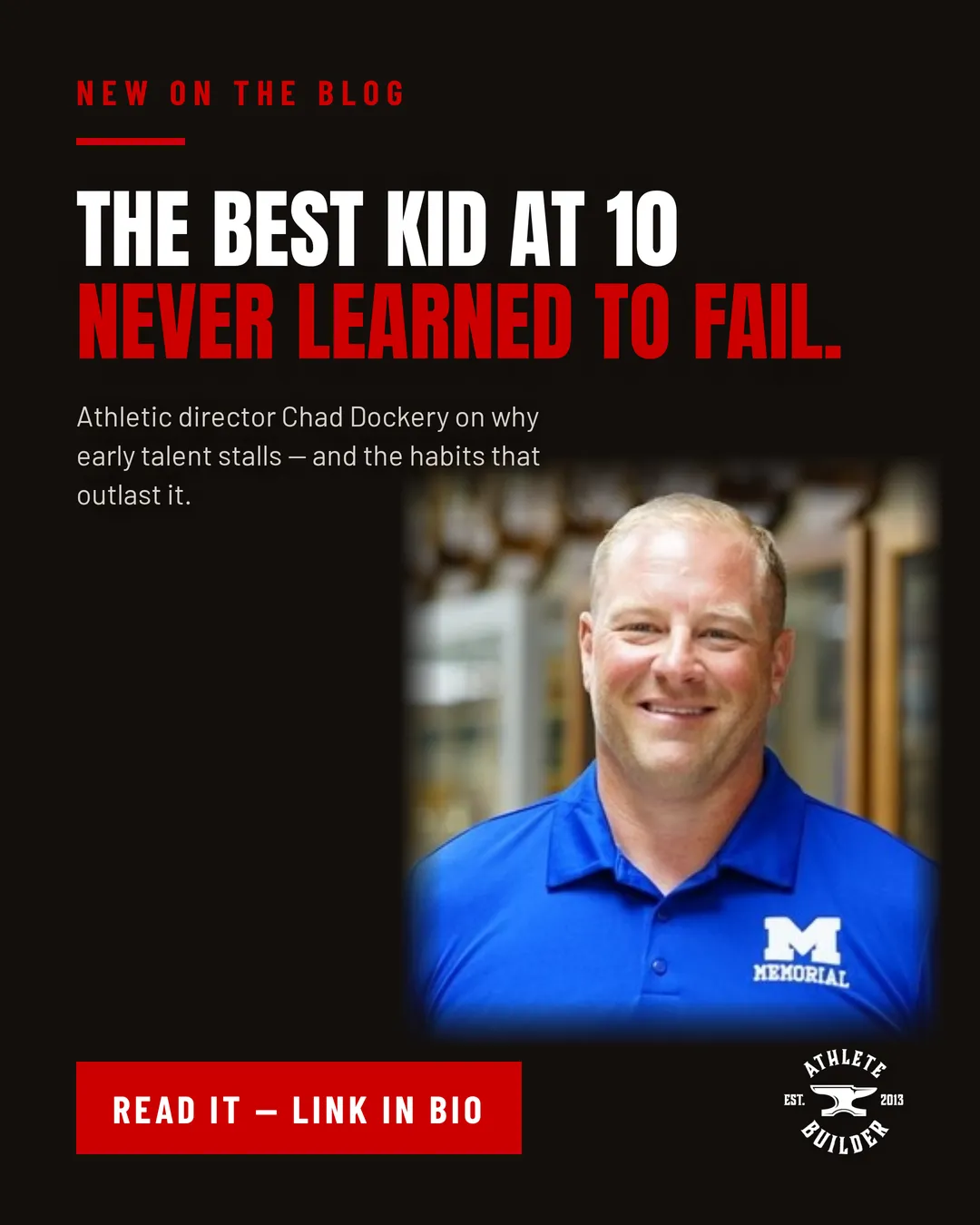
The Best Kid at 10 Never Learned to Fail
The Best Kid at 10 Never Learned to Fail
Walk down to any Little League field on a Saturday morning and you'll spot him in about thirty seconds. The kid who's just better. Faster, bigger, more coordinated. He wins without trying.
Chad Dockery has watched that kid for 26 years as a teacher, coach and athletic director, and he'll tell you what usually happens next:
"A lot of times they get lazy. They don't have to work at it. They just show up and they're better and they win."
Then everyone else catches up. The kids who had to grind have been developing grit the whole time. "Now when things start to get hard for them and it starts to even out a little bit, they don't know what to do. They panic because they haven't had to grind."
His conclusion should stop every parent of a gifted young athlete cold: "They actually are being set back more than they're advancing when they have that much success when they're young."
Chad grew up in a coaching family in Evansville, Indiana — his father coached for 38 years and is in the Indiana Basketball Hall of Fame. Chad played football in college, coached on staffs that won state and sectional titles, and was the athletic director at his alma mater, Memorial High School, when we talked on the Athlete Builder podcast. He's also a longtime friend. This is the conversation every sports parent should hear before next season.
Failure is part of the curriculum
The talented kid's problem isn't talent. It's that nobody made him fail early. "Becoming a winner. A big part of that is failing, and learning to deal with those failures. That's huge."
Chad is honest about why that's hard for parents to accept: "As parents, we're blinded. We're blind with love for our kids." And coaches can make it worse. The kid loses his temper, picks up three straight fouls, draws a technical — and nobody says anything, "because we still won."
The fix isn't to sabotage a gifted kid. It's to keep raising the bar until they hit resistance, and then treat the resistance as the lesson. If your athlete has never lost, never been benched, never gone home frustrated, they haven't been challenged yet. Find the room where they're not the best.
Teach every step — even the obvious ones
Chad's turning point as a coach was realizing that athletes don't know what we assume they know. He points to John Wooden, the greatest coach in college basketball history, teaching players how to put on their socks.
His own version came coaching baseball in South Carolina. An eighth grader who'd had a rough life was struggling before the first game, and kept saying "Nothing, coach. I'm good." League rules required a cup. Chad had bought him one. The kid didn't know what to do with it, because, as Chad put it, "nobody had ever gone through the steps of this is what you do."
I see the same thing in my gym. A kid showed up to max out his squat in Crocs. My first instinct was that he should know better. My second was the right one: he just doesn't know. So you tell him.
For parents, the translation is simple. Before you get frustrated that your athlete "won't" hydrate, recover, eat breakfast or watch film, ask whether anyone has actually taught them how. Chad's staff sat with athletes after practice while they drank their Pedialyte and explained why the whole bottle mattered. That kind of detail is what separates a good team from a loaded one.
Teach them to say "I don't understand"
Chad spent years unable to tell anyone what was wrong. In college he was trying to be someone he wasn't — he'd told his whole family at his graduation party, "I'll tell you one thing I'm not going to do, and that's anything with education." He ended up failing as an athlete and, in his words, as a person, until he admitted he wanted to coach. Twenty-six years in, he calls it the best decision he made.
The skill he wishes he'd had is communication. Athletes don't tell coaches they're confused, because they're afraid it means they're dumb or replaceable. "If kids would get over their pride, if they get over the fact that it's okay to be wrong sometimes, they would really grow as an athlete."
He also teaches athletes to read their own body language on film — shoulders down, sweats thrown, walking up to the next rep already defeated. "You've already set yourself up for a bad performance. And I can see that from watching film."
And watch how he coaches the kid who's stuck. Instead of prescribing, he asks questions and lets them work it out: "If they can come to the answer of why they're struggling or why things aren't going their way, they own it."
Where grit actually comes from
Chad's answer to building grit starts in the weight room, because it's the easiest place to quit: "It's easy to say, nah, not today. It's a lot easier to go hang out at the pool."
The second ingredient is responsibility. "You got to give them the opportunity to lead." And he's clear that leadership isn't volume: "It's not giving that rah speech. It's not pumping their fist... It's reassuring their teammates. It's working hard consistently." He pointed to my son Jack, who played for him, as a leader by example — the guy everyone in the stadium knew was getting the ball, making plays anyway.
The third is consistency, and his definition is the one to post on the fridge: "Consistently is not three weeks. Consistently is not I'm gonna work really hard today and then I'll try again a week from now." Usain Bolt trained for years for a race that lasts under ten seconds. Most young athletes want results in three months.
When progress stalls, Chad's rule flips the usual script: "Find an excuse to get it done. Find an excuse to train." My addition is to widen the scoreboard. If a kid only measures progress by playing time and wins, they get twelve chances a season to feel good. Track the water, the protein, the film, the sleep, and they can win every day.
Protect the work
Asked about nutrition, Chad went straight to the thing that scares him most right now: "Energy drinks." Kids walking the halls and the track with them before training, looking for a shortcut to energy they could have gotten from breakfast and sleep.
His framing is the one that lands with teenagers: the goal is "teaching them not to destroy the work they've put in." Every hour in the weight room can be undone by what goes in the tank afterward. (For anything weight- or body-composition-specific with a young athlete, talk to a registered dietitian.)
And let them have fun
Chad's father got really good as a coach, he says, "when he turned the drill sergeant voice off" and started talking to players like people. Chad's own verdict on the old model: "We are past that period of time where you're going to have consistent success by just saying, be a robot."
His last words to every team before a game are the same: "Have fun. Because if you're just doing it all the time and you're miserable, you're not really competing. You're just trying to get through things."
And his favorite quote belongs on every athlete's wall: what you use today is yours forever; what you fail to use is lost forever.
Find the gap before the season does
Every athlete is built from six blocks — three in the head (Mindset, Knowledge, Teammates), three in the body (Training, Nutrition, Recovery). The gifted kid usually scores high on the physical blocks and has never been tested on the mental ones. The freeAthlete Builder Scorecard(athlete-builder.com/assessmenttest) scores all six in about ten minutes. Better to find the gap in a chair at home than on the field in the one game that matters.
Win the Day. Stay Relentless.
