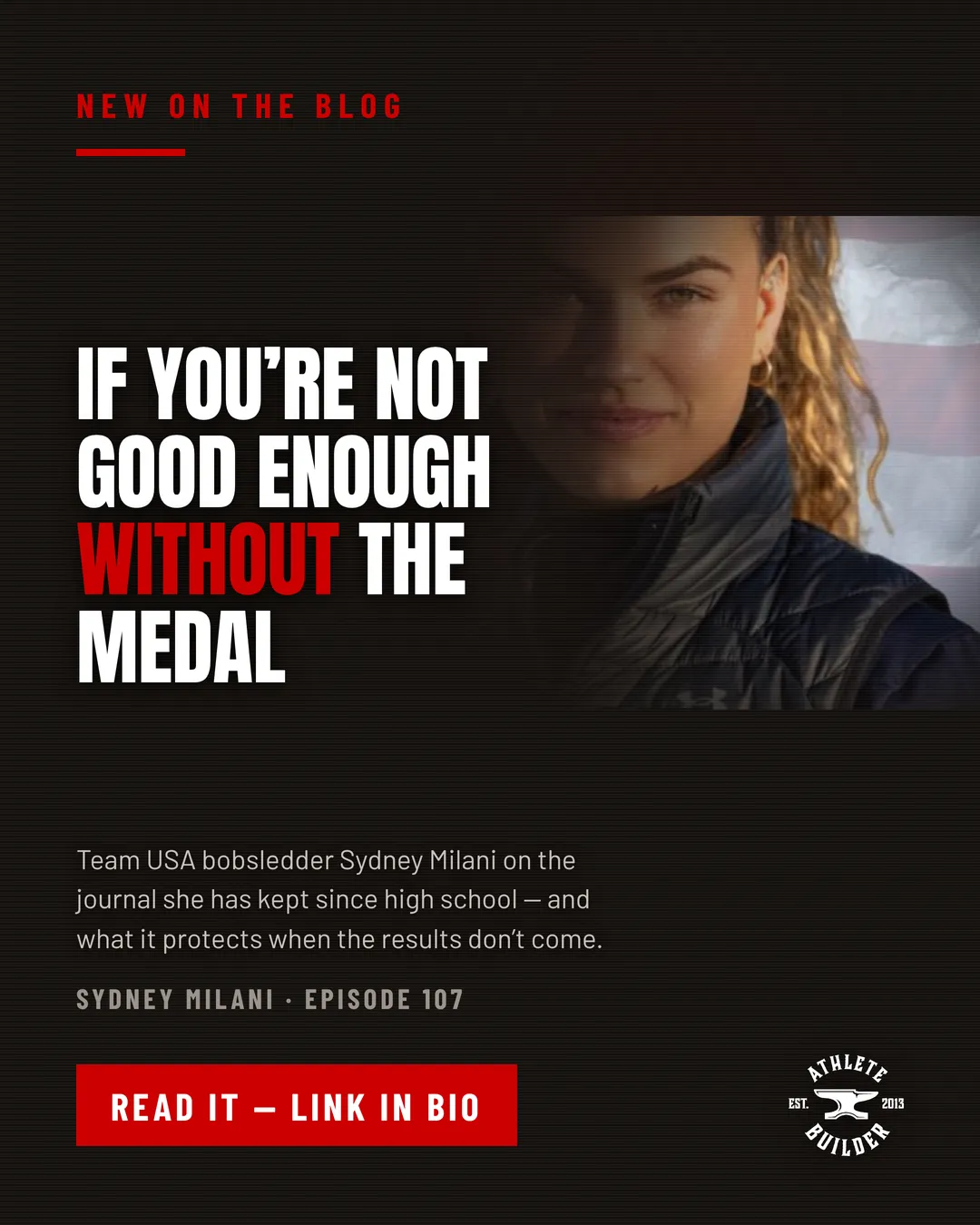
If You're Not Good Enough Without the Medal
If You're Not Good Enough Without the Medal
Sydney Milani set the state record in the 100, the 200 and the 400 as a high school senior in Iowa, then went and won the 800 for good measure. She was an All-American and a team captain at Alabama. She got a voicemail from Team USA while she was standing at track practice and assumed it was a spam call.
She is now a bobsled brakeman chasing an Olympic team.
And the sentence she keeps coming back to is a line from a movie about the Jamaican bobsled team.
"If you're not good enough without the medal, you're never gonna be good enough with it."
She does not say it as a consolation. She says it as an operating rule — and she has a fifteen-year habit that enforces it.
The habit came from her dad
Milani grew up on a farm in Iowa, second of five girls, coached by her father.
"I was born and raised on a farm in Iowa, so we got them tough farm roots... He was a very big influence in my life and kind of beat it into me. You got to stay resilient."
Parents should sit with why that landed instead of grating, because coaching from a parent usually grates. Her answer:
"It was easy for me to follow his direction because there was merit there, because he did it all the time. I saw how fit he was and how strong he was and successful he was and I was like, I want to be like that. Like everything you're saying makes sense to me."
He was a firefighter. He worked the farm. He was in the gym. He ate the way he told her to eat. The instruction always had a demonstration attached to it — and that is the entire difference between a parent who is coaching and a parent who is nagging.
The journal came the same way:
"I've been journaling since I was in high school. My dad journaled, so that's where I got the habit."
She was not handed a system. She watched one.
What's actually in it
Fifteen years later it is the operating document of a professional career.
"In my journal, I track what I eat, I track what I drink, I track pre and post training thoughts. My annual plan is in my journal. I do a debrief at the end of the day. Like it has everything in it."
"I'm probably a little bit too dependent on it, to be honest, but it's never far away from me. It's literally sitting on my table right here."
The part most athletes skip is the part that makes it work. She gave it away.
"I gave my coach full access to it. I was like, look at my journal, keep me accountable."
"Sometimes I'd turn around and coach would be looking at my journal and then looking up at the weight that I was using and he'd be like, didn't you do this weight last week? It says right here in your journal. And I was like... yeah, I did. He'd go put five pounds on the bar."
A private journal is a diary. A journal your coach can open is a system. Same notebook, completely different function — one records what happened, the other changes what happens next.
The structure is an after-action report: what were the inputs leading into game day, how did game day go, what were the results, what were the lessons. It is the same debrief a unit runs after a mission, and almost no high school athlete in the country is running it.
She did everything they asked. It still cost her.
Here is the part that makes the rest of it matter.
Moving from track to bobsled meant a different job description. A sled has a weight maximum, and the closer a crew gets to it with their own bodies instead of ballast, the faster the start. Milani is 5'4" and the shortest athlete on her team, and she was asked to add a significant amount of body mass across the four-year cycle leading into the Olympic trials.
She did it. Exactly as prescribed, tracked and scored in the journal, for four years.
"I did what they asked me to do. I gained the weight, so I can never be upset at myself. However, that is probably what ultimately screwed me."
"I just couldn't train that tissue fast enough to be fast and be twitchy anymore. I was strong as an ox, but bobsled is more than just being strong. You have to be fast too."
She competed at the trials carrying that weight and watched her sprint numbers fall off the ones that got her recruited out of a track program in the first place. Her verdict: "I will never gain weight like that again."
That is a professional describing a competitive trade-off in a sport with a rulebook weight cap — the same category of decision as a wrestler choosing a class or a lineman adding size for a position. It is not a template for anybody else. Any change to a young athlete's body composition belongs in the hands of a registered dietitian who knows the sport and the athlete, and under eighteen that goes double, because growth is already the largest variable in the equation.
But the lesson underneath it is one every athlete eventually meets. She was completely coachable. She tracked every input. She executed a four-year plan without missing a step. And the plan was still wrong for her.
"I don't think I've ever told a coach no... There are very few people in this world who I would just blindly trust, but they are one of them. If they tell me to do something, I'm gonna do it."
Compliance is not the same thing as control. That is worth saying out loud to a sixteen-year-old who believes that doing everything right is the same as being guaranteed the outcome.
The outcome is not the deliverable
Milani is direct about what holding on too tight did to her going into the trials.
"I was just holding so tightly onto this result. I just wanted to win so bad... I think that's really common for athletes just to want to be control freaks."
She is equally direct about where she puts the part she cannot hold:
"All you can do is plant the seed by doing everything that you possibly can, but then calming your mind and your spirit and just letting Him do the rest."
"The reality of it is you can do everything that you possibly can, but the outcome isn't up to you. And so if you don't find peace in that, then sports aren't going to be enjoyable anymore."
You do not have to share her faith to take the structure of it. Every competitor needs somewhere to set down the part of the result they never had access to, because the only other place to put it is on themselves — and an athlete who does that is an athlete on a short clock.
What the journal is actually for
Wins in the sport Milani picked are rare and far apart. The push is a matter of seconds. The cycle is four years long.
"There was a point in my athletic career where my worth was determined by wins... My journal helps me find purpose and helps me keep myself grounded."
That is the real function, and it has almost nothing to do with sets and reps. Jim's version:
"If I'm trying to win and be the best version of myself daily, then the next day — hey, my goal is to get up and do some recovery. And if I do those things, I get some wins."
Motivation is weather. Discipline is climate. A page that shows an athlete a real, small, specific win on a Tuesday in February is the closest thing there is to manufacturing motivation on purpose — and it is the only scoreboard available every day, which matters when the real one shows up once every four years.
She is also building something that will outlast her own results. Most athletes in her sport pay their own way — travel, competition fees, all of it — while chasing a spot on the team.
"I cannot stand watching my teammates live out of their cars. I can't stand watching them not be able to fly home to see their family because they can't afford a plane ticket."
So she started a nonprofit to fund them. She also serves as an official teammate of the Navy SEAL Foundation — Athlete Builder's own philanthropy — after working as a strength coach in a Foundation-funded program for operators, and she is the one who pitched the program that now pairs elite athletes with those teams.
Her favorite quote, half-remembered on tape and worth keeping anyway: do not fear imagined troubles.
Parents, here is the takeaway. The journal is not a training tool. It is the thing that tells your athlete who they are on the days the results do not.
CTA
Want a clear picture of where your athlete actually stands — mindset, knowledge, teammates, training, nutrition and recovery? Take the free Athlete Builder Scorecard. It takes a few minutes and you get a real read, not a sales pitch.
Take the free Athlete Builder Scorecard
Watch the full conversation with Sydney Milani — Episode 107:
Win the Day. Stay Relentless.
