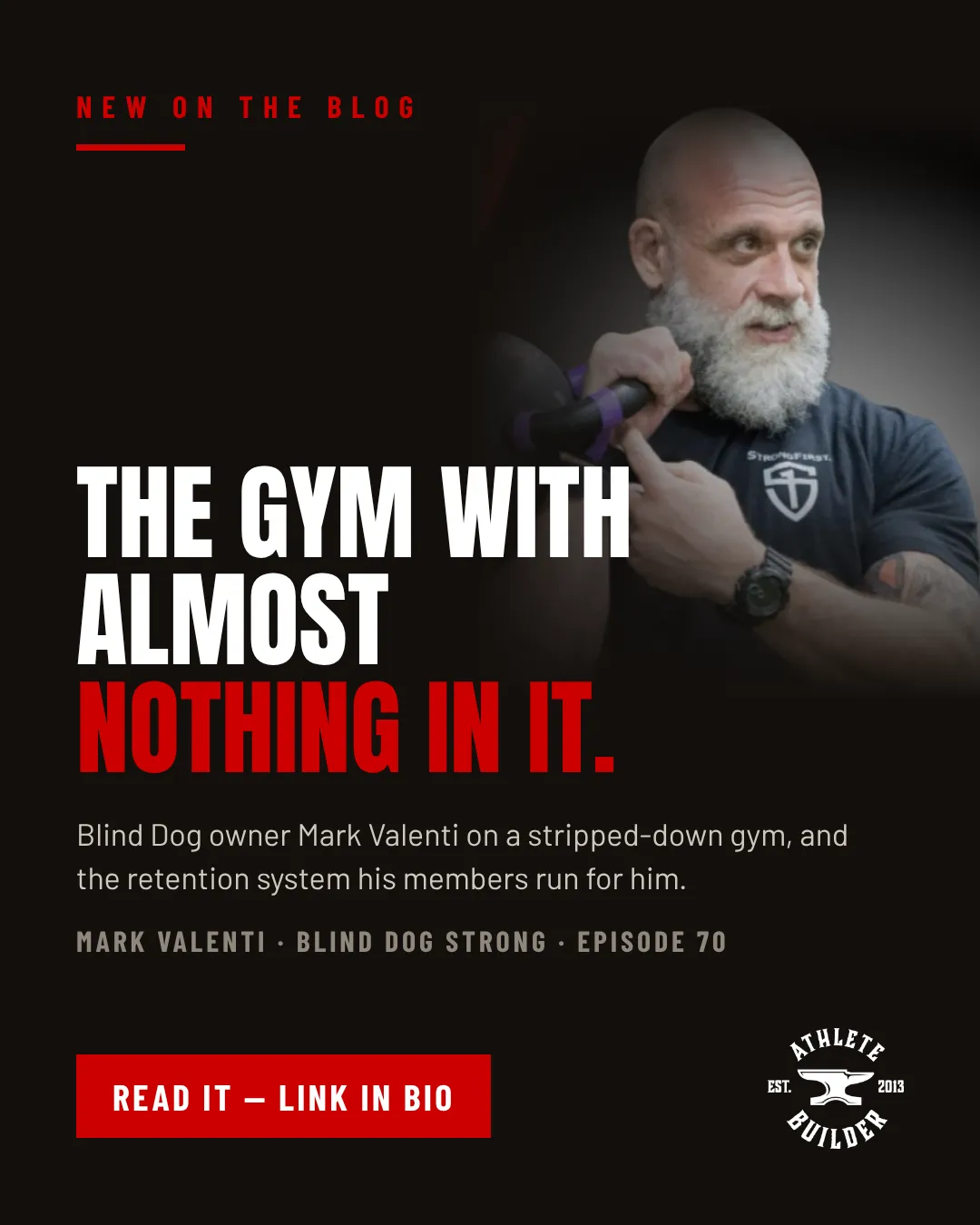
The Gym With Almost Nothing in It
The Gym With Almost Nothing in It
Walk into Mark Valenti's gym and you might think it's half moved in.
"It's a rig down the middle but we have very little equipment. We have bars and plates. We have kettlebells and some dumbbells and that's about it."
That's on purpose. Mark has owned Blind Dog, now Blind Dog Strong in Vermilion, Ohio, since 2012. Before that he spent 17 years as a professional Highland Games thrower, always ranked in the top 10 in the U.S., and trained young athletes out of other people's gyms. He's a StrongFirst kettlebell instructor and a big reader. I've known him for years.
He's also proof that a gym doesn't need to be big or shiny to work. It needs to be clear about who it's for and what it's doing.
It started in a garage with a leaky roof
Mark bounced from gym to gym training athletes starting in 1996. "After about the fourth gym where the owner just kind of irritated the crap out of me, I went home and cleared and cleaned out my two car garage with the leaky roof."
The kids followed him. It was freezing in the winter and brutal in the summer. "Last four year we were in that place, we had seven kids going to college athletics out of this 20 by garage."
Owners, write that one down. The athletes didn't follow the equipment. They followed the coach.
His wife was the one who pushed him to open a real gym. "Sometimes you just need someone to say that to make it happen."
Pick who you serve
Mark told me COVID changed his business for the better. "I stopped getting clients who wanted to lose 12 pounds for a wedding and started getting clients who wanted to get healthy and strong and that really spoke to me."
He used to dislike personal training because people came in for a quick fix and disappeared. So he built for the people who wanted to stay: adults 35, 40 and up, 30 minutes in and out, focused on strength. The young athletes went to another coach on his staff.
That's a business decision more owners should make on purpose. You can't be everything to everybody with a small staff. Mark chose the client he wanted to keep for years, then built the gym, the schedule and the equipment around them.
Personal training, not private training
This is the part I'd steal first. Mark draws a line between private training and personal training.
Personal, in his gym, means "I'm personally putting together your workout. I'm going to put you through that workout. But you're not going to be the only person in the gym." Three or four people, each on their own plan, at the same time every day.
What happens next is the best retention system I've heard described:
"If they don't show up for a couple days, the text messages start to go back and forth. Hey, where are you? So it's not even something I have to do."
The members keep each other coming. In Mark's view, having someone who cares whether you show up "is nice for some of these people just to know that they have a friend group there that is concerned about them."
You get the individual program people will pay more for, and the accountability of a class, without hiring more coaches. If your one-on-one clients train alone, try putting three of them on the same hour and see what happens to attendance.
Do the least you need to do
Mark has a younger coach working with his athletes who reminds him of himself at 25: more is better, Olympic lifts, high box jumps, speed work. Mark isn't saying he's wrong. Those kids will get better. But here's what he'd tell his younger self:
"Slow your roll. do the least amount you need to do with them to get them strong and fast."
His version is hard kettlebell swings and Turkish get-ups, plus teaching kids to brace and breathe properly. Build a base so solid they can "walk into a college weight room and be set for life."
For owners, that's an equipment budget and a coaching standard in one. Simple works when the coaching is good. And less equipment means less setup, less breakdown, and more time coaching the person in front of you.
Hold your coaches to a physical standard
Mark loves StrongFirst for one reason in particular: you have to pass physical standards to get certified, and you have to keep passing them. "If you're 60, you're 70, you still have to keep recertifying every three years." No pass, no title.
That's a standard worth thinking about in your own building. Your coaches don't have to be elite lifters. But members notice whether the people coaching them still train.
Start kids with a handshake
Mark still runs a kids' kettlebell club for junior high athletes. The first thing he teaches isn't a swing. It's a handshake. Stand up, look him in the eye, squeeze. "Can they shake my hand and look me in the eye? And then once we teach him that, then we start work."
Phones aren't allowed while they train. And when they're done, he tells them to put the phone away: "talk to your father on the way home. Drive home, talk to your parents."
It's not just lifting. It's coaching young people to be better humans, and parents notice that faster than any PR.
Now what?
Mark's favorite quote: "When ships were made of wood, men were made of iron."
Three questions for your next staff meeting:
1. If you lost half your equipment tomorrow, could your coaches still deliver results?
2. Who is your gym built for, and does your schedule show it?
3. Which of your clients train alone, and who would text them if they stopped showing up?
If those answers bother you, that's worth a conversation. Book a Game Plan Session and bring your numbers.
And if you want to see where one of your own athletes stands across all six blocks — Mindset, Knowledge, Teammates, Training, Nutrition, Recovery — the free Athlete Builder Assessment takes 8–12 minutes.
Win the Day. Stay Relentless.
— Jim Beebe
Watch the full conversation with Mark Valenti — Episode 70: https://youtu.be/OA5AQnLf8gU
