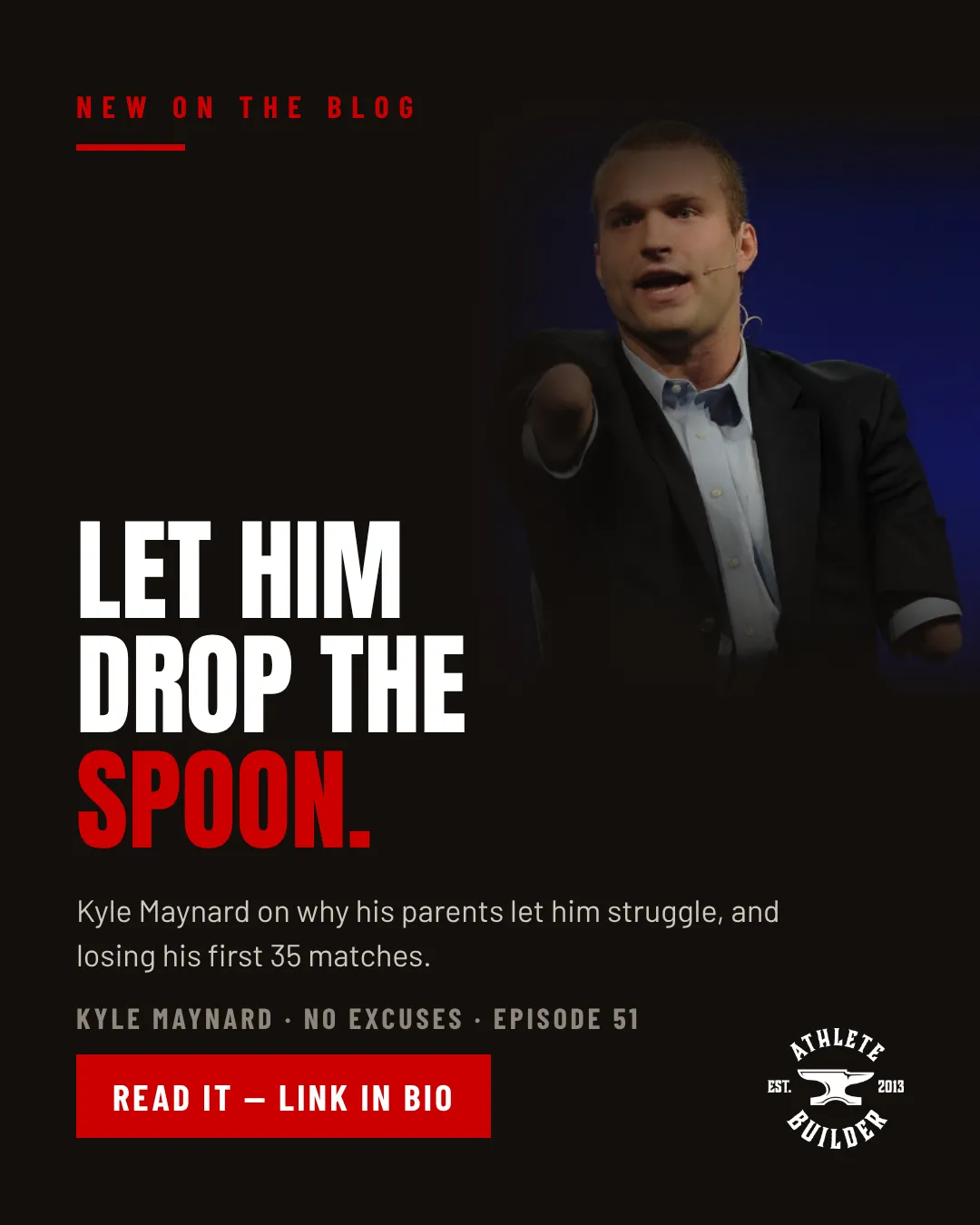
Let Him Drop the Spoon
Let Him Drop the Spoon
When Kyle Maynard was a little boy, he had to learn to pick up a spoon. He dropped it. Then he dropped it again. Hundreds of times, he told me. Maybe thousands.
His mom could have fed him. She wanted to. In Kyle's words, "She said that, you know, was a mom, she would have helped feed me forever."
She didn't. His parents watched him struggle until he figured it out.
Kyle was born a quad amputee: his arms end at the elbows and his legs at the knees. He didn't use prosthetics. He wrestled from sixth grade into college. He bear-crawled to the summit of Mount Kilimanjaro and Mount Aconcagua, one of the highest mountains in the world. He competed at the 2015 jiu-jitsu World Championships as a purple belt. He wrote the New York Times bestseller No Excuses, won an ESPY, owned a CrossFit gym for more than ten years, and has given close to a thousand keynote talks.
None of that happens if somebody keeps feeding him.
The struggle is coming anyway
Here's how Kyle explained what his parents understood:
"I think if they had, you know, made things easier for me in different kinds of ways, I think that, you know, it would have been a very different struggle at some point."
And then: "the struggle in life, it's going to hit you no matter what, it's going hit you at different points, no matter what, you can't avoid it."
Parents, that's the whole job in two sentences. You can't keep the struggle away from your kid. You can only decide whether they meet it prepared. Every time you do it for them, you take a rep away.
I tell parents the same thing with shoelaces. You can tie your kid's shoes forever. You can teach them. Or you can hand them the shoe and let them figure it out. The kid who figures it out learns to tie a shoe, and he also learns he can solve a problem nobody solved for him.
Zero and thirty-five
Kyle lost his first 35 wrestling matches. "Just over and over and over and over again for like a year and a half straight."
He's honest about it. He was close to quitting. "I'm certain that there's no way that I would have continued to do it. Had I not started winning."
But he kept showing up long enough to start winning. And the reason, by his own account, wasn't talent:
"For me, the work ethic was the like differentiator."
That meant staying after when his teammates went home. "Like there's still work to do, you know, like we got to like go and do sprints or whatever."
If your athlete is 0-and-something right now, that's not the end of the story. It might be the first chapter of a good one.
Shake their hand
Kyle's grandmother taught him a lesson he still uses. She took him to the grocery store, put him in the front of the cart, and they went up and down the aisles practicing one thing: meeting people.
"She said that when people hear your voice and they see your face and they shake your hand The disability will go and fade away."
"It kind of became, kind of became true," he said.
Every kid has something they think people see first. Teach your athlete to stand up, look people in the eye and shake their hand. It changes what people see, and it changes how your kid sees himself.
Everybody's got something
Kyle's family taught him that he wasn't the only one with a hard road. "Everybody's got something. Everybody's got, you don't know what somebody else is going through."
His wrestling coach had a line for kids who complained about an injury, and Kyle remembers it with a laugh: he'd say Kyle probably wished he had a wrist or an ankle to break. It shut people up fast.
The point isn't to compare pain. It's that your athlete is not the only one who's behind, hurting or doubted. The ones who get somewhere just keep moving anyway.
Pick a weak point and hammer it
I asked Kyle what he'd want any audience to walk away with. His first answer:
"Pick a weak point and hammer it."
We all like working on what we're already good at. Kyle's advice is the opposite. Find the thing that's holding your athlete back, whether it's conditioning, confidence, sleep, schoolwork or how they handle a loss, and go after that one thing.
His second answer was a mantra he learned from his first Navy SEAL friend, for the moments when you think you're done: "Not dead, can't quit."
And his third: "where the attention goes, the energy flows." What your athlete focuses on before the big moment is what shows up in it.
Get in the room with the best
When Kyle moved to San Diego to train jiu-jitsu, he went to one of the best academies in the world. "For the first six months I was there, it was brutal." He got beaten every day, and he told me he wanted it that way.
Then he went home to visit his old gym and started submitting the people who used to beat him. He hadn't realized how much he'd improved until he was back with them.
If you're the best one in the room, your athlete's growth slows down. Find the room where they're the one getting beat, and let them stay there long enough to catch up.
Now what?
Kyle's favorite quote: "Do not go where the path may lead, go instead where there is no path and leave a trail." That's Ralph Waldo Emerson.
Three questions to answer at home this week:
1. What are you still doing for your athlete that they could learn to do themselves?
2. What's the one weak point your athlete avoids, and what would hammering it look like for a month?
3. Who in your athlete's world is better than them, and how much time do they spend in that room?
If you want to know where your athlete really stands, start by measuring it. The free Athlete Builder Assessment scores all six blocks — Mindset, Knowledge, Teammates, Training, Nutrition, Recovery — in 8–12 minutes, and points to the one to work on first. It's free for families.
Win the Day. Stay Relentless.
— Jim Beebe
Watch the full conversation with Kyle Maynard — Episode 51: https://youtu.be/87-SBFSwV-Q
