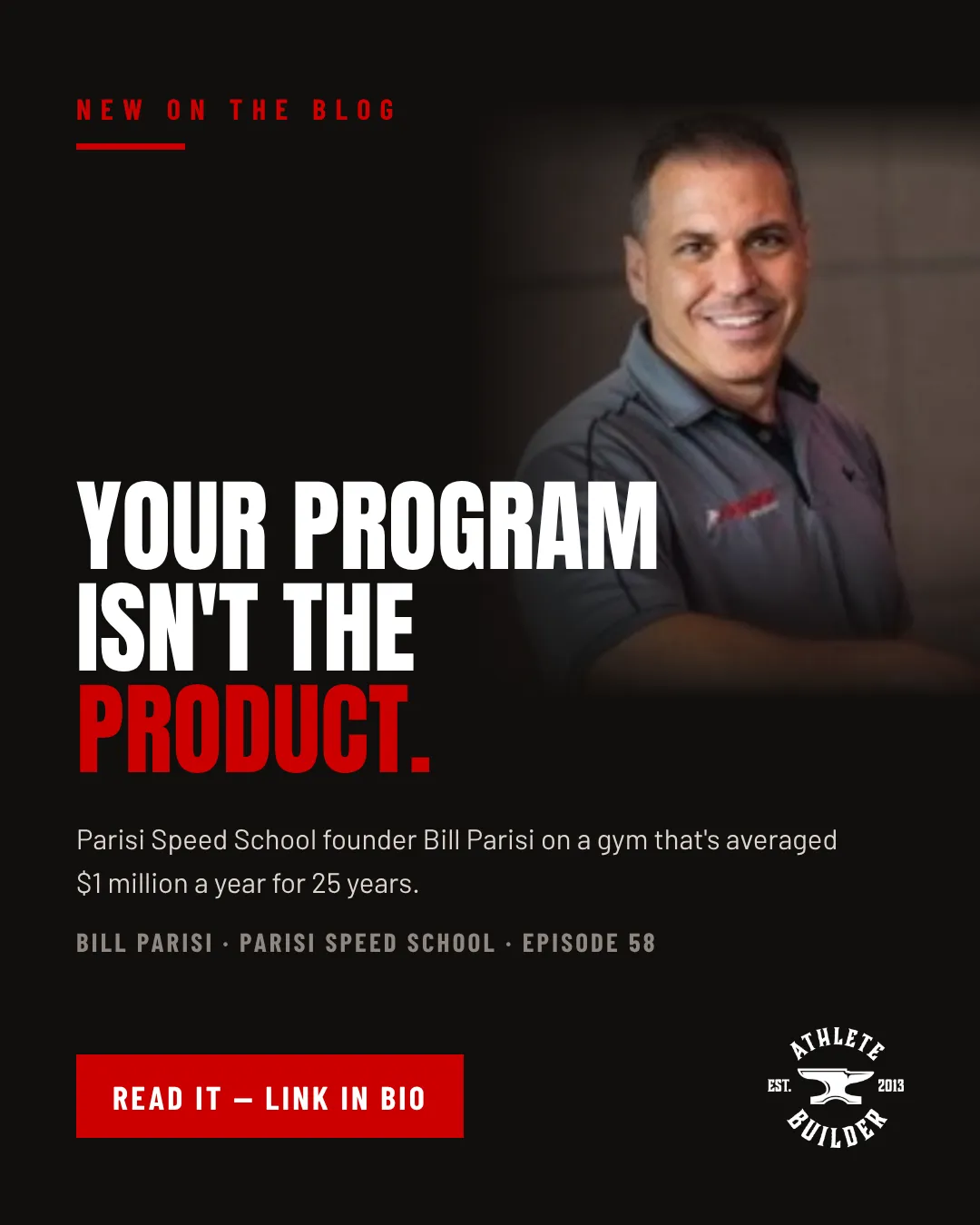
Your Program Isn't the Product
Your Program Isn't the Product
Most gym owners I talk to are trying to fix their business by fixing their programming. Better periodization. Better speed drills. A new piece of equipment.
Bill Parisi would tell you that's half the job.
Bill founded the Parisi Speed School in the early '90s. When he came on the show, I listed what it has grown into: over 120 facilities, more than 600 coaches, over a million athletes trained and 130 NFL draftees. He was a two-time Division I All-American javelin thrower, and he wrote a book called Anatomy of Speed.
But the number that stopped me was one gym. His facility in Fair Lawn, New Jersey.
"for 25 straight years we've averaged a million dollars of revenue every year for 25 straight years."
Some years more, some years less, he said. The average held for a quarter century. In youth sports performance, that is rare. So I asked him how.
Lose by two inches, then get obsessed
Bill's answer starts with a loss. As a high school senior he was one of the top javelin throwers in the country. At the junior nationals in 1985, the top two finishers made the junior Olympic team. He was in second place going into the last throw of the meet.
"I got beat on the last thrower, last throw of the meat by two inches."
"I said, I'm never gonna let something like this happen to me again. I'm always gonna be more prepared."
That quest took him to Iona, to clinics and seminars around the world as an undergrad, to Finland to train with world-class throwers, and eventually to Florida, where he cold-called Steve Spurrier to ask for a graduate assistant spot. Spurrier said no at first. Bill persisted and got it.
"Your biggest setback is your biggest opportunity," he told me. "You don't get better always succeeding."
Owners, the same is true of a business. The gyms that last usually have a moment like that, a loss that made the owner more prepared than everyone else.
The burger test
Here is the part every owner should hear. Bill asks people a simple question. If you're having friends over for Sunday football, do you serve them McDonald's burgers, or do you buy good meat from the butcher and grill your own?
Everyone says they'd make their own. So his follow-up is: if your burgers are that much better, why aren't you competing with McDonald's?
Because McDonald's has something most of us don't.
"McDonald's has a delivery system. Now their products aren't great, but people know what they're getting"
His conclusion for coaches: "you gotta serve a filet mignon, but it's gotta be consistent, right? That delivery has to be great."
Most of us in this industry are proud of our product. We know our programming is better than the big-box gym down the road. But the family walking in doesn't buy your periodization. They buy the experience of being coached, every session, the same way, by people who know their kid's name.
Bill was clear that you need both. Some people have incredible delivery and average content and still do well, "because they have just incredible relationships they build with their athletes and their coaches and their people." But "when the rubber meets the road, you really got to have both to be sustainable."
Coaches who stay
The other thing that keeps a gym alive for 25 years is the staff. This industry burns people out. Bill said it himself: "this is a very transient industry. A lot of people get burned out."
At Fair Lawn, it looks different.
"They come in as interns, now they're married with kids and have houses, and they're still coaches for us."
Some of his coaches have gone on to build their own names. He mentioned Martin Rooney and Joe DeFranco both started with him. He's proud of that too. But he's built the place so good coaches don't have to leave to make a real living.
How? "You got to set a standard. And you got to set a high standard for yourself, you got to set a high standard for your organization. It starts with core values, your core mission."
If your best coach left tomorrow, would it be because they outgrew you, or because you never built a place they could grow into?
Always over-deliver
When I asked Bill how his mindset of delivering more than expected flows down to his affiliates and coaches, his first words were these:
"success is really not that complicated. It's just hard work."
His goal has always been to over-deliver. Not just with the science, the programming and the speed drills, but with how the whole experience is delivered.
Bet on the farm kid
Bill also gave me a picture every owner can use with parents. Take two wrestlers, same weight, same technical skill. One grew up in the city lifting weights in a gym. The other grew up on a farm baling hay.
"Most people bet on the farm kid. He's got that farm boy strength."
His explanation is that the farm kid spent his whole life loading his body in every direction, not just squat, deadlift and bench. That's a programming lesson, but it's also a sales lesson. Parents understand the farm kid instantly. Use pictures like that to explain what you do.
Stay a student
The last thing I'd point out is Bill's humility. After 35 years in the business, he's still reading research, connecting scientists who didn't know each other, and lecturing college strength staffs. He described it as a constant quest:
"You never truly master anything. It's the constant never-ending pursuit."
The owners who stop learning are usually the ones who are sure they have it figured out. If your ego isn't on the line, you can be wrong, learn something and turn out a better product for the athlete.
Now what?
Bill's favorite quote: "Life is a gift. You make it precious."
Three questions for your next staff meeting:
1. If a new family walked in tomorrow, would they get the same experience from every coach on your floor?
2. Where is your delivery weaker than your program?
3. What would it take for your best coach to still be with you in 15 years?
If those answers bother you, that's worth a conversation.Book a Game Plan Sessionand bring your numbers.
And if you want to see where one of your own athletes stands across all six blocks — Mindset, Knowledge, Teammates, Training, Nutrition, Recovery — the free Athlete Builder Assessment takes 8–12 minutes.
Win the Day. Stay Relentless.
— Jim Beebe
Watch the full conversation with Bill Parisi — Episode 58: https://youtu.be/R24JVnN874M
