What Youth Sports Are For — and What Broke Them
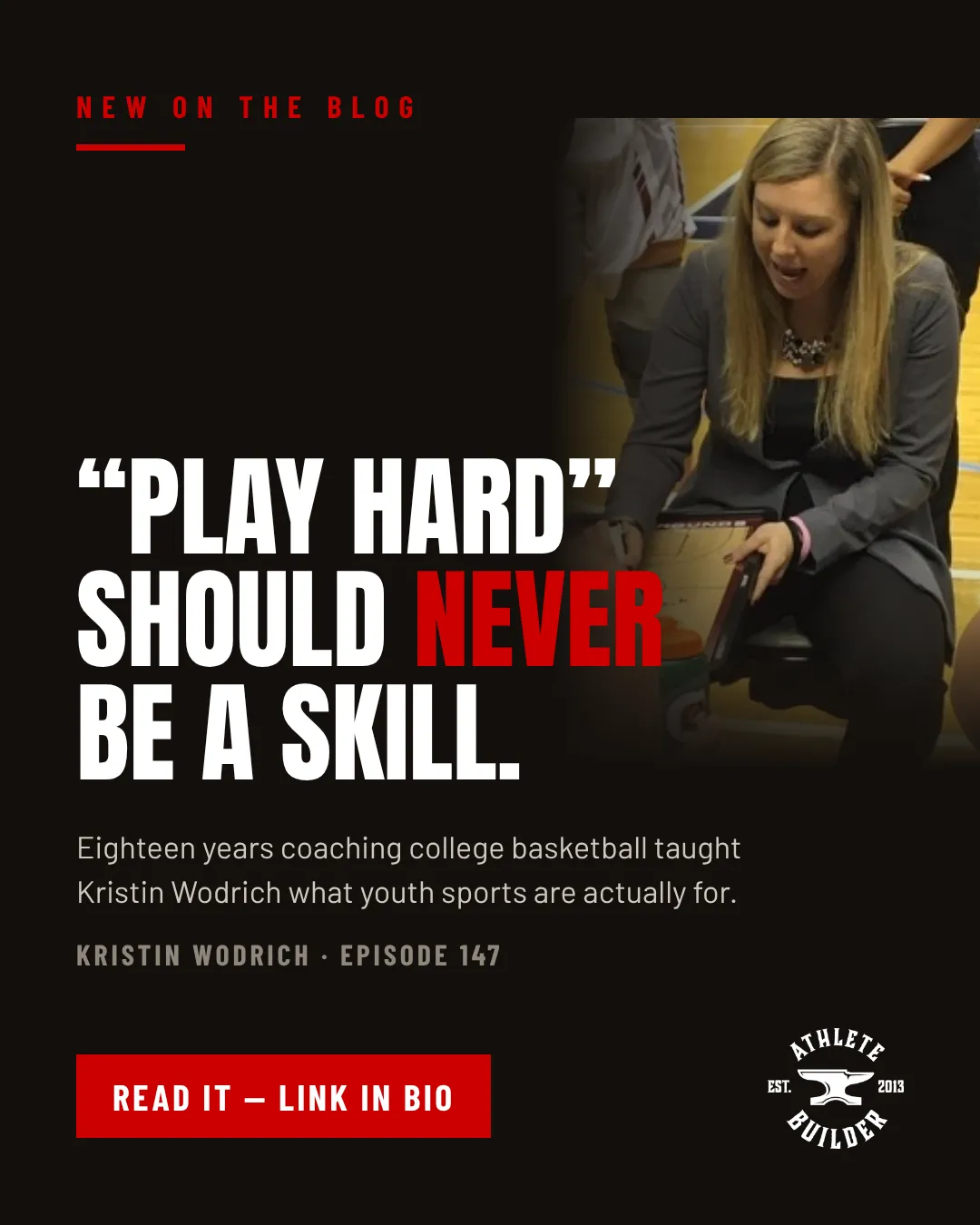
"Play Hard" Should Never Be a Skill
Kristin Wodrich spent 18 years coaching women's college basketball, after playing Division I at UMBC. She has run whiteboards in arenas so loud she couldn't call a play out loud. She has coached captains, recruited, and sat across from players in the hardest conversations a coach has.
Then she stepped away from college coaching. She's now an assistant athletic director at Heritage Christian, lives here in Indianapolis, and is a mom of three boys.
So when I asked her what's broken in youth sports, she didn't need a minute.
"I think the expectations of youth sports are broken."
What youth sports are actually for
Here's the list she gave me, word for word: "the expectations should be they're learning to love a sport, they're getting better, they're getting exercise, their mechanics are getting better, they learn how to be a good teammate, they learn how to be good loser."
Then she told me about her six-year-old at basketball camp. He got second in knockout. He had to go chest bump the winner. Then he went out again and got second again.
"That's what those are for," she said. "That's what those moments are for. It's it's learning how to listen and be respectful and play hard, right?"
And then the line that stopped me:
"Because play hard as a basketball coach, like I was writing that down as a skill set. That should never be a skill set."
Read that one again, parents. A college coach caught herself writing "play hard" down as a skill set, as if it were rare. Effort used to be the entry fee. Somewhere along the way it became a selling point.
What changed? Her answer: "the expectations now are just you have fifty trainers and they need to be a certain way and people want scholarships and now there's money involved, right?"
[EPISODE EMBED: https://youtu.be/dNe1F3QA7Mc]
The burnout pattern a college coach sees
Kristin sees where those expectations lead, because she coached the kids on the other end of them.
"I've just seen kids get older and this their motivation is different, their why is different, why they're doing it. They get burnt out so quickly, so then we transfer really quickly."
She's careful to be fair about it: "transferring's not bad in itself, right? Some kids, transferring is the right thing to do." Her worry is the reason behind it. "Sometimes it's the easy way out."
Her fix for the parent at home is simpler than most of what gets sold to families: "if your kid practices and does what they're supposed to, like they're gonna develop. And if you put them around good people, they're gonna develop."
Practice. Do what you're supposed to do. Be around good people. That's not a package with a price tag. It's a standard.
The parent who isn't there every day
My favorite part of the conversation was about her husband, who also coached women's basketball. People assumed the two of them went home and broke down every game. They didn't.
After her games, he held back. "I'm not there every day of practice. I don't have an opinion," he'd tell her. "Like you didn't play this player. Maybe she was a turd in practice, or maybe matchups weren't great. Like you watched more film than I did."
Kristin's take: "If parents thought about if parents thought like that, can you imagine how much easier life would be? If like parents and fans thought like that, like I'm not there every day. I don't see what's going on."
That's not a call to stay quiet about everything. It's a filter. Before the car-ride conversation about playing time, ask yourself the question her husband asked himself: was I at practice? Did I watch the film? If not, your athlete needs a parent tonight, not a second coach.
Where the real edge is now
This is where I jumped in, because this one matters to me.
When I was a kid, making the all-star team was the separator. You got a few extra weeks against better competition, and you got better. Now, as I told Kristin, "everyone's playing all stars or travel ball all the time. The competitive advantage is completely neutralized."
So where does an edge come from when everyone has the same one?
My answer on the show: "Two days a week, three in the offseason, they don't practice. They just lift." Build the back side of the body that sport-only kids leave weak. Get stronger and more powerful. That makes an athlete more durable and more available, and it's an edge most of their competition doesn't have.
Kristin, mom of a six-, four- and two-year-old, asked the question every parent asks next: how young?
Younger kids don't need a barbell. Climbing a tree, push-ups, handstands against the wall: that's real resistance training for a seven- or eight-year-old, and it's fun. By middle school, keep it simple. My words on the show: "You have them push heavy things and carry heavy things." Sleds forwards, backwards and sideways. Carries with sandbags and kettlebells. Pull-ups and body-weight work. Even jumping off things and landing well matters, because absorbing force on landing is a strength skill too.
Kristin laughed that her boys are already "jumping off everything, climbing on everything." Good. Let them.
The identity underneath it
One more thing she said, and it's the one I'd want every sports parent to hear.
"A lot of times your sport becomes your identity. Well, your sport's gonna fail you. Your coach will fail you. Your teammates will fail you at some point."
For Kristin, that foundation is her faith. Her point for any family is the same: basketball "is a vehicle to help people grow. Basketball is a passion of ours. But it's not who we are."
The athlete who knows who they are without the sport is the one who can handle losing in knockout twice, a bench season, or a transfer decision without the bottom falling out.
And the line she used with every player she coached works at the kitchen table too: "I love you right where you're at... but I love you too much to keep you there."
Now what?
Three questions to answer at home this week:
1. Does your athlete play for the reasons on Kristin's list — love of the game, getting better, being a good teammate, learning to lose — or for a scholarship that hasn't been offered yet?
2. Before your next conversation about playing time, were you at practice?
3. If everyone on the team plays the same travel schedule, what is your athlete doing that the others aren't?
If you don't know where to start, start by finding out where your athlete actually stands. Thefree Athlete Builder Assessmentscores all six blocks that decide an athlete — Mindset, Knowledge, Teammates, Training, Nutrition, Recovery — in 8–12 minutes, and points to the one to work on first. It's free for families.
Win the Day. Stay Relentless.
— Jim Beebe
Watch the full conversation with Kristin Wodrich — Episode 147: https://youtu.be/dNe1F3QA7Mc
