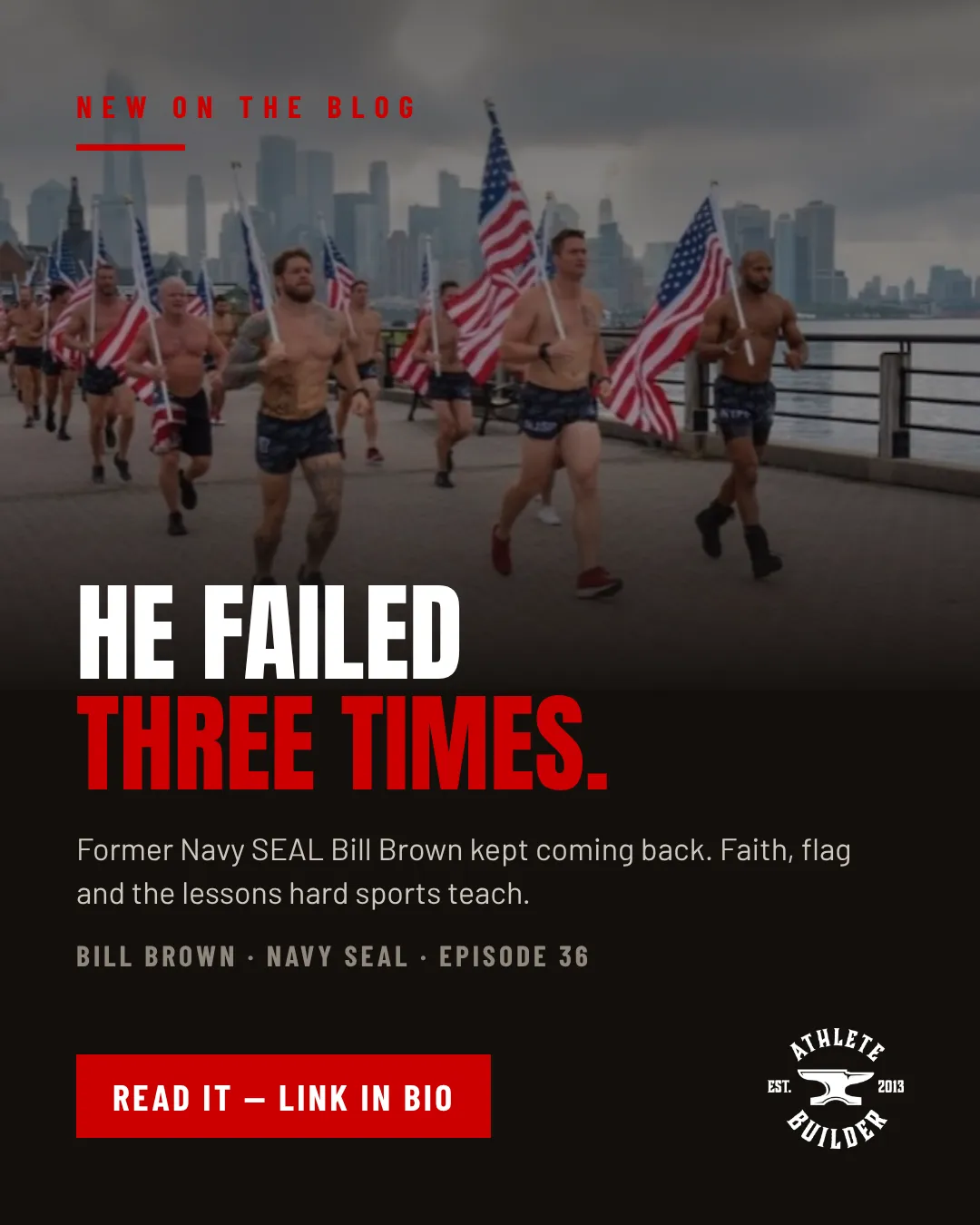
He Failed the Swim Test Three Times
He Failed the Swim Test Three Times
Bill Brown wanted a shot at SEAL training. First he had to pass the swim screening.
He failed it. Then he failed it again. Then a third time.
"I failed the first three times because of swimming, but I kept coming back."
Most of the guys in his boot camp division who failed didn't come back. Bill did. An instructor noticed, and instead of making him take the test again, "he literally spent like two hours with me just trying to upgrade, you know, teaching me a modified breaststroke." Bill barely passed on the fourth try. That got him orders to BUD/S.
Bill went on to serve eight years in the Navy with three deployments, the last one in Iraq. He went through BUD/S in the same boat crew as Kenny Bigbee (also on our show) as well as David Goggins, who wrote about him in his book. After the Navy he used the GI Bill, fell in love with learning, and graduated from Rutgers Law School. When we recorded, he was an attorney and the organizer of the New York City SEAL Swim, which raises money for the Navy SEAL Foundation.
He also told me plainly where he started: a blue-collar kid who made some bad decisions, was out on his own the day he turned 18, and needed a way out. In his words, "the Navy 100 % saved my life."
Here's what his story says to parents and athletes.
Hard sports aren't the dumb choice
Bill said something I hear parents dance around all the time:
"A lot of families out there now is they actually think it's not an intellectual pursuit to have their children in football or some of these, or wrestling or boxing, some of these competitive sports, but I actually totally disagree."
His reason: "it builds a certain confidence you don't get in other avenues, especially football, which is a team sport. You take some hard, hard hits. You learn about victory through glory. You learn how to deal with loss."
Wrestling ran in his family. His grandfather wrestled, his dad picked it up, and his dad taught him. He learned "a lot of hard lessons" on the mat, "especially about the grind."
I've coached a lot of wrestlers, and I love having them in the gym. When you're used to getting your face pushed into the mat, putting a barbell on your back is no big deal.
Your athlete doesn't need to play a collision sport. But don't count out the hard ones because they look rough. Some of the best lessons in them only come from being uncomfortable.
The runs he hated
The best story in our conversation is about Bill's dad.
His father was a veteran and the first in the family to go to college. His first job out of school was under a boss who wanted him to fudge the numbers. He wouldn't, so he got treated badly, and he couldn't afford to quit. So he ran. Long distance, early mornings and nights, while working and taking night classes.
For young Bill, those runs were the only time he got with his dad. So he ran too, and he hated every mile of it.
"But one of the things that it did is it taught me about life. And a lot of times life sucks, but you keep going."
Parents, read that twice. Your kid may not remember the pep talks. He'll remember the miles you did next to him. Whatever your version of that run is, a lift, a walk, rebounding in the driveway, the time together is doing more teaching than the words.
Get out of the orbit
Bill was honest about the crowd he ran with before the Navy. They weren't bad guys individually, he said. "But you put us together and we were making poor decisions."
His advice to any young athlete:
"If the guys or your friends, the individuals you're associating with, and there's a certain pattern forming, well, chances are that it's going to have a strong gravitation to you and your opportunities in your future."
He saw it and made a decision: "I got to get out of this orbit."
Then he landed in a boat crew where the competition never stopped and the guys next to him were the best he'd ever seen. That changed him. The people around your athlete will raise their standard or lower it. There isn't a neutral group.
Be the quarterback in the pocket
Young guys who want to try out for the SEAL teams still call Bill for advice. He tells them the instructors will find them eventually. Everybody gets checked. When it happens, "you're going to feel like it's the end of the world and the pressure is going to be heavy."
His advice: "be that quarterback in the pocket, stay calm. You know, if you, if you messed up, do whatever you can to fix it."
That works for a freshman in a varsity game, a kid in a tough tryout, or a senior in a hard week of school. Stay calm, fix what you can, and live to fight the next play.
Skill or courage?
Bill once asked a member of the Gracie family, the jiu-jitsu legends, which mattered more, courage or skill. The answer was skill: "if you have skill, you don't need courage." Then Bill asked a SEAL friend the same question. His answer: "I think you need both."
I'm with his friend. Every time an athlete does something harder than they've ever done, it takes some courage. And the courage is easier to find when they've built the skill in practice.
Bill saw how. When he got to BUD/S, he watched trainees who hadn't been through Hell Week yet "on their own time, they were going through the course, trying to pick up things." They were building confidence in the skills they'd be tested on before anyone tested them.
That's the habit for your athlete. The extra work on their own time is where the confidence comes from.
Faith and flag
Every year Bill leads the New York City SEAL Swim. SEALs, special warfare veterans, police officers, firefighters and serious swimmers cross from Liberty State Park past the Statue of Liberty and Ellis Island to lower Manhattan, about three miles of open water. They run in formation with the flags held high, and the money goes to Beyond the Brotherhood.
Bill told me what the swim is for: "a positive patriotic message of unity for our entire country." And he means it. "A lot of people don't realize how beautiful our country is. Like our country really is beautiful."
Before the swim starts, and before every airplane he ever jumped out of, Bill prays. "I'm what you would call a foxhole Christian," he said, "But I am smart enough to realize when it's when anything's under my leadership, it's probably a good thing to give glory to God."
That's a good model for a young athlete. Know who you serve, and know who you're grateful to. A kid who plays for something bigger than himself, his faith, his family, his team, his country, has a reason to keep coming back after the third failed test.
Now what?
Bill's favorite quote comes from Revolutionary War general Nathanael Greene: we fight, get beat, rise, and fight again. That's the swim test in one line.
Three questions to talk about at home this week:
1. What's one thing your athlete has failed at that's worth one more try?
2. Who are the five people your athlete spends the most time with, and which way are they pulling?
3. What's the hard thing you could do next to your athlete this week, not just tell them to do?
If you want to know where your athlete really stands, start by measuring it. The free Athlete Builder Assessmentscores all six blocks — Mindset, Knowledge, Teammates, Training, Nutrition, Recovery — in 8–12 minutes, and points to the one to work on first. It's free for families.
Win the Day. Stay Relentless.
— Jim Beebe
Watch the full conversation with Bill Brown — Episode 36: https://youtu.be/DT8dHULqwAs
