
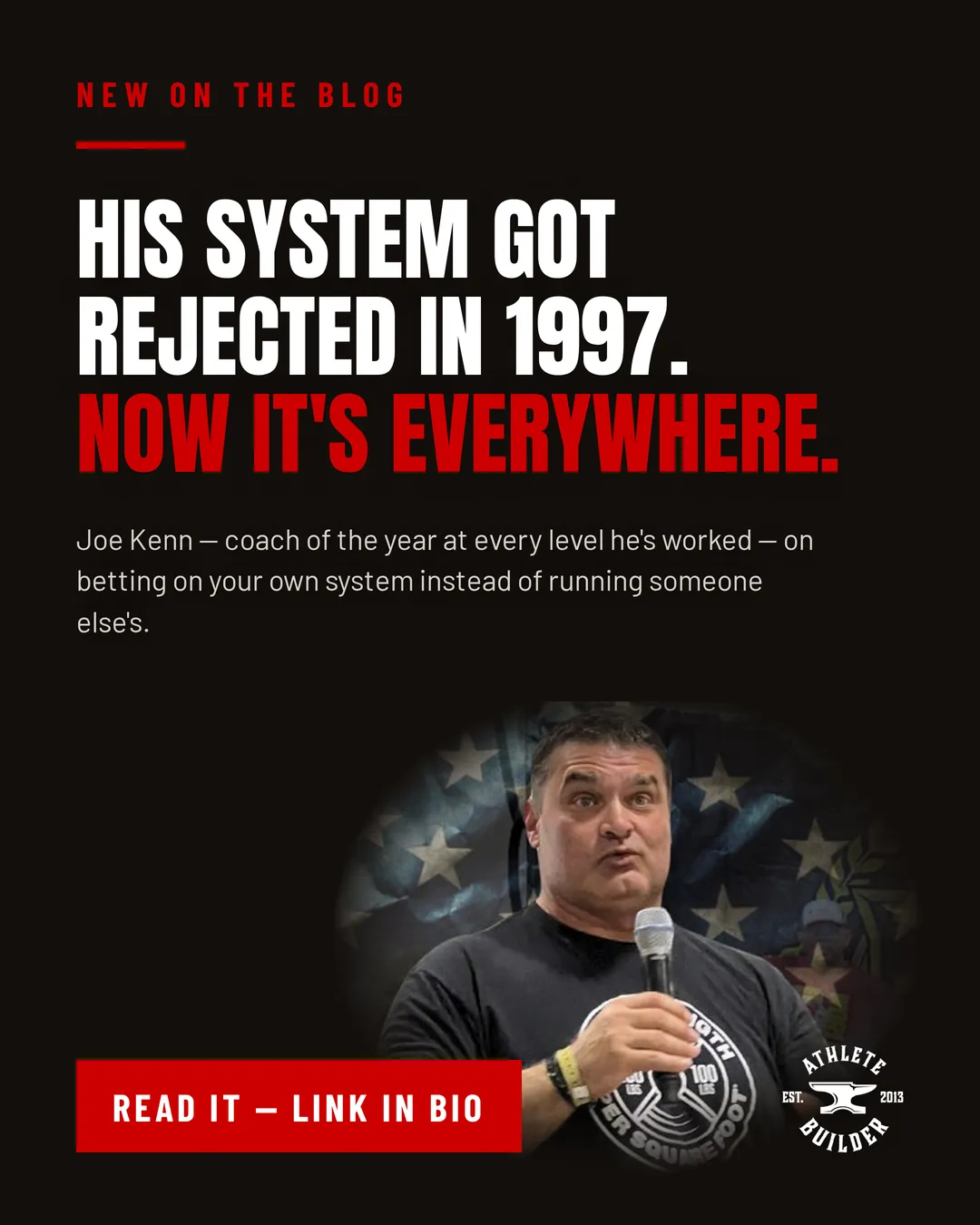
Rejected in 1997. Now His System Is Everywhere
Rejected in 1997. Now His System Is Everywhere.
In 1997 a young strength coach at Boise State submitted an article to the NSCA describing a training model he had built from scratch. It got rejected.
The reviewers told him you cannot snatch after a squat. You cannot do this after that. Joe Kenn's read on the verdict, nearly thirty years later, is the most useful thing any coach can hear about expert opinion: "Peer reviewed is a hogwash for a coach. People who've never coached are not peers. They're somebody else's peers. They're not mine."
That rejected model was the Tier System. It is now a worldwide template for training team-sport athletes.
Kenn played at Wake Forest, blew out his knee, and came out of college classified a medical reject. He turned the weight room into a career that has included Boise State, Arizona State, Louisville, and the Carolina Panthers — and coach of the year honors at every level he has worked. He has written three books, and today he is VP of performance education at Dynamic Fitness and Strength while coaching elite strongman athletes on the side. On Episode 93 of the Athlete Builder podcast, he explained how a guy with no pedigree in the field built something the field now runs on.
The scoreboard that actually matters
Start with how he answered the introduction. I ran through the résumé — the awards, the levels, three decades of it — and he stopped me: "The one thing about team sports and individual awards, none of that happens without the athletes first and foremost, and then your staff. They didn't work for me. I always felt like we worked together."
Then his definition of the job, which belongs on the wall of every business that employs coaches: "I don't think a leader's ultimate goal is to have a tremendous amount of followers. I think it's your goal to develop and mentor leaders."
His proof is not the trophies behind him, which he called his propaganda shelf. It is the number of his former staff now running their own programs. For a facility owner, that is the honest measure of whether you have built a business or just a job: how many people who worked for you are now good enough to compete with you.
It's their team
Here is the section every owner who works with schools and clubs should read twice.
Kenn walks into his first meeting with the women's basketball coach at Boise State — an ex-football player about to inherit her program's weight room, and she is already tired of getting handed the old football program. His posture: "First thing you learn as a strength coach is, it's their team. You can be called God's gift to the weight room, but when you walk into that coach's office, you're their assistant. That's not going to change. You just have to be well prepared and have enough ammunition that when you go in there, you have a plan of attack where you get what you'd like to get and they get what they'd like to get."
And he did not dismiss her complaint. He went back and thought about it: "She's not really wrong."
That is the whole relationship in two moves. Accept that the sport coach owns the team. Show up prepared enough that they still get your system. Owners who fight that first part lose accounts. Owners who skip the second part become a rental space.
Four things every coach should know about what they know
Kenn has a ladder he uses to describe professional maturity, and it gets better at every rung: "I know what I know, I know what I don't know, I know what I need to know — and now I'm old enough to say, I know what I don't care to know."
That last rung is the one that saves a career. The field produces infinite new things to chase. His filter: "I'm gonna invest my time in studying the things that I need to know rather than what I don't care to know."
On learning itself, his advice is about reading between the lines: "There's a reason why most papers have a space in between each line. People who are really trying to figure things out are gonna look in between those lines." He describes studying Westside the same way — taking what he needed for a three-day-a-week program and understanding that some of what mattered was never written down.
Why running someone else's program will cost you
Kenn built the Tier System because he questioned a convention nobody was questioning — the heavy-moderate-light week. His conclusion: the structure was flawed, because the first exercise of the day is always your best one before fatigue accumulates, so only the moderate day produced real quality. So he rotated the explosive, lower-body and upper-body work through the session order, and built a model where every day was productive and athletes had to express power under fatigue — which is what their sport demands in the fourth quarter or the fifth set.
Then he says the part that should worry anyone hiring or being hired: assistants get promoted out of big programs because a coordinator wants that program — "but the problem is, that assistant isn't really understanding how and why that program works." Take a system built for five-star athletes at a blue blood, run it verbatim at a smaller school, and it will not work. "But that coach doesn't know any better. So they're like, we're gonna do this."
His own standard with his staff: "I'm gonna teach you everything I know, but at the end, you gotta figure it out when it's your turn — because you gotta be able to believe in your heart the same way I believe in my heart." He is blunt about how rare that is: "I don't think there's enough independent and free thinking going on in strength and conditioning."
If your facility's methodology is a copy of someone else's, you cannot defend it, you cannot adapt it, and you cannot sell it. Kenn's whole career is the argument for building your own — and it started with a rejection letter.
Jim's not losing 30 pounds when he breaks the huddle
Kenn is not anti-technology — he uses velocity data with the strongman athletes he coaches. His objection is to handing judgment to the machine, and he makes it with the best image on the tape.
Auto-regulating software drops an athlete's load when the bar slows down. But: "Let's just say me and Jim are playing each other in football. At some point I'm going to fatigue and slow down. Now that machine's going to tell me to reduce the weight 30 pounds. Well, here's what I'll tell you when I'm tired — Jim's not losing 30 pounds when he breaks the huddle."
The drop-off is the information. "I need to know how that athlete drops off to know what his conditioning levels are." And on where the numbers come from: general charts are a guide, not gospel, because someone else's control group is not your roster. His standard is the one owners should adopt: "Evidence based research is what my evidence says in my training hall."
His other caution is about the human being running the session: "The ability to motivate is never not going to be important in sports. Doesn't matter where you go with AI... if you don't have heart and you don't understand what that feeling of heart means, it's going to be hard to have some type of emotional attachment to helping somebody succeed." What happens when a coach jumps in an athlete's face and the next set is the best one? No software accounts for that.
What you are actually selling
"It's not transferable strength. It's build confidence. If you can get these kids confident and teach them competent technique, the rest is up to the skill coach and the position coach to turn them into a player."
And his measure of an athlete's progress is where they started, not what they lifted. His older son could do a full Nordic curl on day one. His younger son could not hold his chin over the bar for five seconds — and now, at 260 pounds, does fifteen dead-hang pull-ups. Kenn calls that possibly the biggest athletic accomplishment of the kid's career.
The kid who does their first push-up bought something no leaderboard captures. That is exactly why our freeAthlete Builder Scorecard(athlete-builder.com/assessmenttest) baselines athletes across six blocks before anything else — the delta is the product, and you cannot show a delta you never recorded.
If you own a facility
Kenn's mantra is Words Win — right action, right speech, do the right thing when nobody is looking, and count what you have accomplished instead of what you have not. His framing of his own career is worth stealing for any operator having a rough quarter: he wanted the NFL and got hurt early, but he started 22 games in Division I football, and plenty of people would love to say that.
If you want to talk through building a system you can actually defend — yours, not a copy — book a Game Plan Session: link.closersoftware.com/widget/bookings/ab-gameplansession.
Or answer this one: if someone asked you why your program is built the way it is, could you explain it without naming the coach you got it from? Hit reply and tell me. I read every one.
Win the Day. Stay Relentless.
317-224-6960