
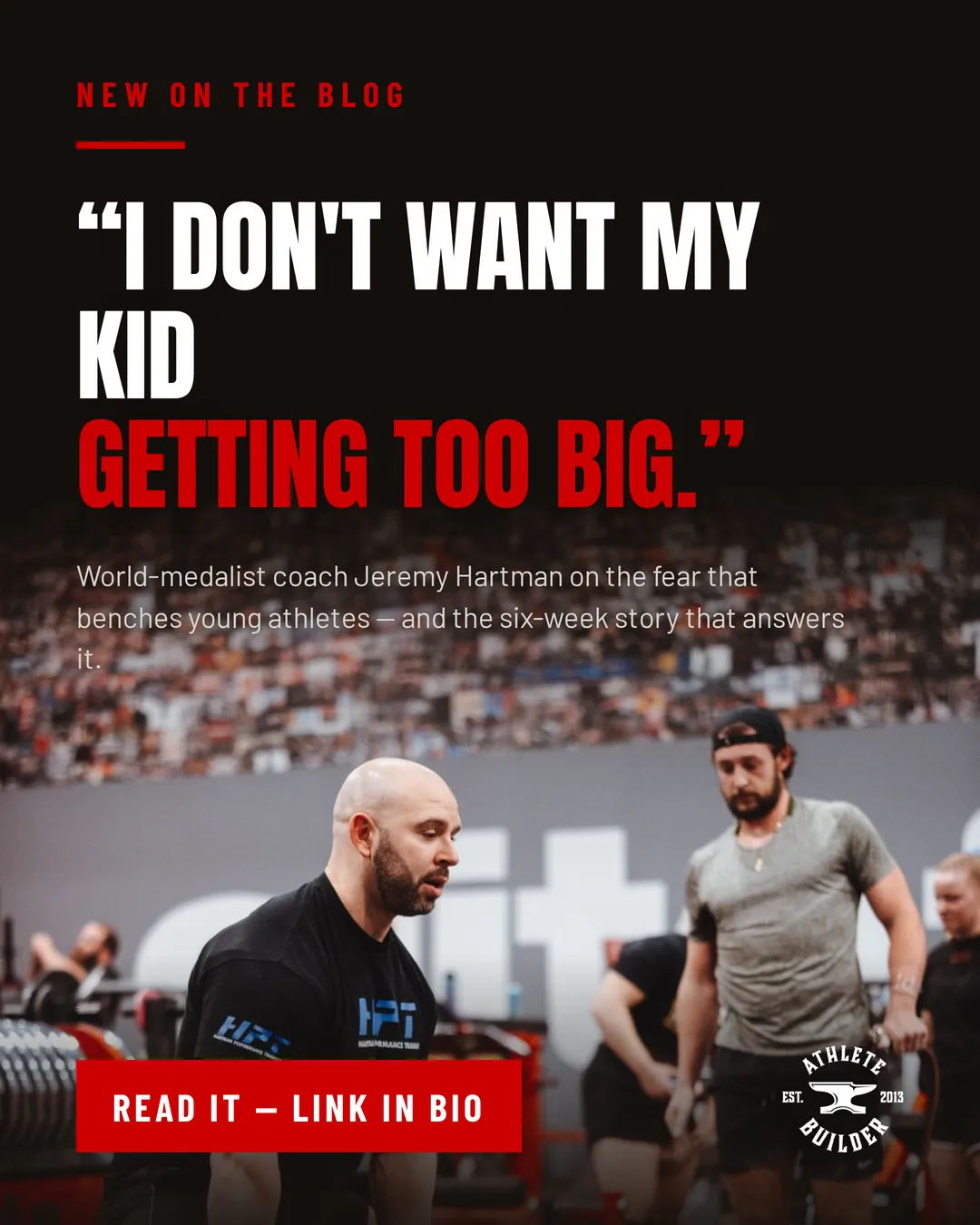
"I Don't Want My Kid Getting Too Big"
"I Don't Want My Kid Getting Too Big"
Jeremy Hartman hears the same two sentences from sports parents over and over: "I don't want to get my son too big. I don't want my daughter looking like a guy."
His observation, from decades of coaching, is blunt: "Those are the kids and those are the people that sit on the sidelines."
Hartman has earned the right to say it. He won a bronze medal in the bench press at the 2009 IPF World Championships — 523 pounds at a bodyweight of 217 — and a gold-medal 782-pound deadlift on the world stage. He spent more than fifteen years as a high-school strength coach before opening Hartman Performance Training, where he has coached lifters to all-time world records and national titles. On Episode 56 of the Athlete Builder podcast, he made the case every sports family needs to hear: strength is the foundation, and fear of it is what actually holds young athletes back.
The coach who trained him for free
Hartman's whole career traces to one man he still calls Mr. Conch. His youth football coach invited him to start strength and conditioning work the summer before sixth grade — and never charged a dime. Mr. Conch was a metal fabricator, so he welded his own sleds "before they even made sleds... before they were even prowlers." Backpack runs with weights. Farmer walks. Hill pushes. Years of general physical preparation before Hartman ever touched a barbell.
"Three years of GPP training like that, you can't replace that. I don't care who you are... There was a reason why my body ate up the barbell lifts when I got into high school."
His coaches couldn't figure out how he was making gains that fast. He could: the base was already built. And the debt shaped his life's work: "What he did for me is 100 percent of the reason why I do what I do today." Hartman is in his forties and still calls Mr. Conch when he faces a hard decision.
Here's the parent takeaway hiding in that story: the coach who changed his life wasn't selling highlight reels or exposure. He was giving a sixth grader sleds, loaded carries, and years of patient base-building. That's what a life-changing edge actually looks like.
The six-week proof
Now the story that answers the "too big" fear directly.
A family brought Hartman their daughter — a hurdler and high jumper — in the middle of her season. That almost never happens; parents wait for the offseason, or for something to go wrong. She had been hurt, and when he assessed her, the problem was simple: "She was so weak... I got like, hey, I got six weeks. I'm going to do what I can. I gave no promises."
Six weeks of real strength work later, she qualified for state in the hurdles and the high jump. At regionals she was seeded in lane one — "which is like, good luck, hope you place. She ended up winning the whole thing."
She kept training. She stopped being afraid of putting on lean muscle. And as a true college freshman she placed fourth at collegiate nationals — an All-American. Hartman's summary of the mechanism could not be simpler: "Every time she gets a little bit stronger, she jumps a little bit higher." And because everything around her hips and spine is strong, she's still jumping well at the end of the season, when the athletes around her are worn down and hurting. In his words: "She's healthy at the end of the season and she's strong... you can't put a price on that confidence."
Meanwhile, the families still protecting their kids from the weight room are watching from the bleachers.
Why strength comes first
Young athletes today scroll past their heroes' training clips and want to copy the flashy finishing touches — the bands, the balance work, the exotic drills. Hartman's answer when a wrestler brings him an elite athlete's routine: "Look at what he did for all the 25 years before that style of training, before he's at this elite level now." The pros earned the fancy stuff with decades of heavy, boring basics. Copying their dessert without eating their dinner builds nothing.
The physics don't negotiate: "They literally have to get stronger to produce more force into the ground. That's not everything. They still have to sprint, they still have to have good mechanics... but strength is the foundation."
And the age advantage runs opposite to what most families assume. "These kids at this age, they are recovery machines. They can do multiple stuff multiple times a week." The teenage years aren't the time to protect an athlete from work. They're the cheapest years of adaptation a human being ever gets.
Winning the day when you don't hit the number
One more gift from this episode, because it's the mindset piece your athlete can use this week. One of Hartman's young lifters had a rough squat day — chasing a personal record that never came. Instead of letting him leave defeated, Hartman reframed the tape: "Dude, you just hit three sets over 800 pounds for doubles. Have you ever done that in your life?" The lifter's response: "I got a whole new definition of winning the day."
That's coaching, and it's also a portable skill. A bad game, a lost match, a stalled lift — the question isn't only "did I hit the goal?" It's "what did I just do that I've never done before, and what does today's work make possible?" Hartman builds that trust deliberately: "I would never give you a number you're not going to be able to hit."
He closed with the quote he's carried since childhood, from wrestling legend Dan Gable: "You can never wrestle enough, because you can always get better. You can never lift enough, because you can always get stronger."
Find out where your athlete actually stands
Every athlete is built from six blocks — three in the head (Mindset, Knowledge, Teammates) and three in the body (Training, Nutrition, Recovery). In our experience, Training is the block families most often leave underbuilt — not from laziness, but from fear, the exact fear Hartman named. The freeAthlete Builder Scorecard(athlete-builder.com/assessmenttest) scores all six in about ten minutes and shows you the weak block. If your athlete's is Training, you now know the story of what six weeks can do.
Win the Day. Stay Relentless.
317-224-6960