
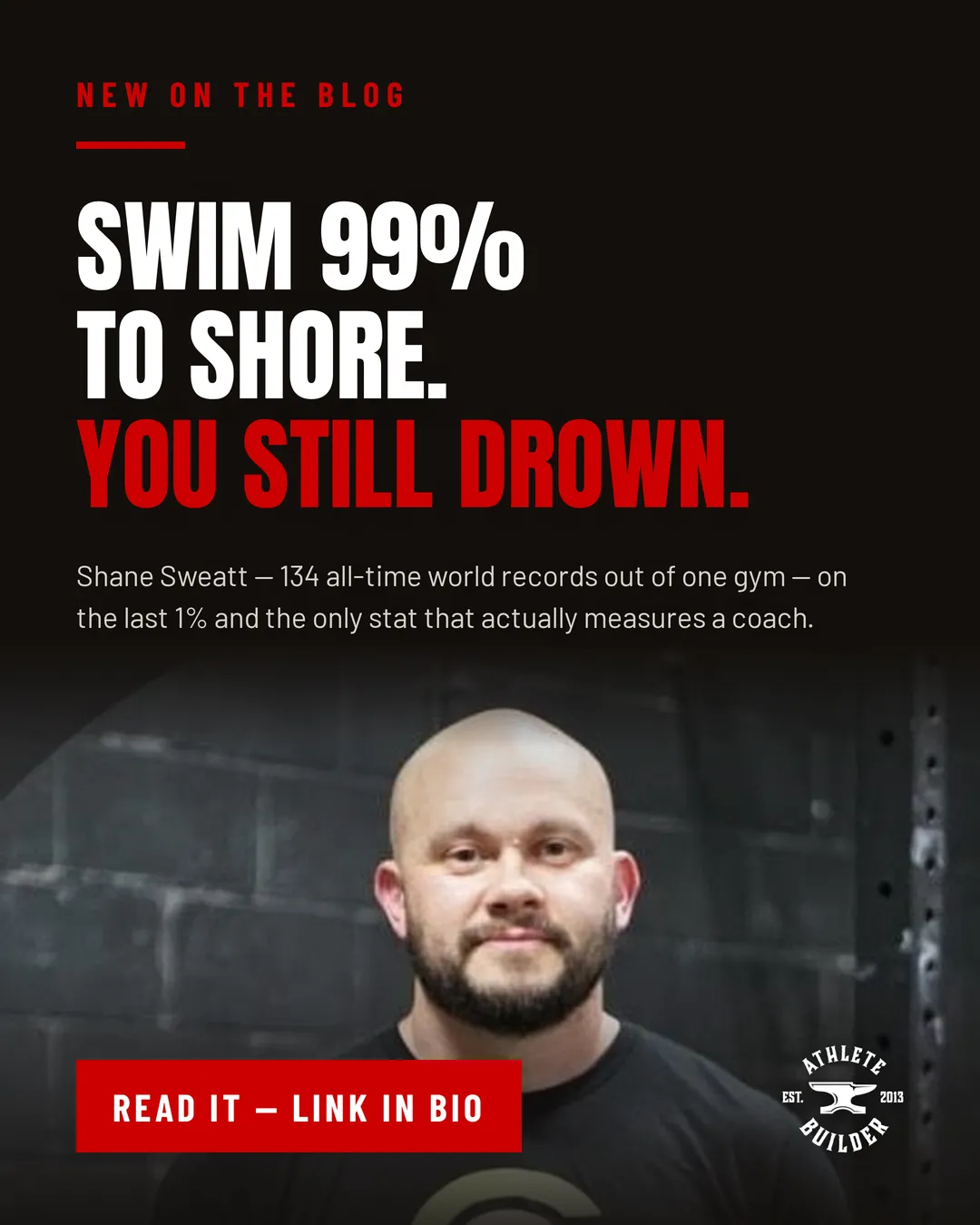
Swim 99% to Shore and You Still Drown
Swim 99% to Shore and You Still Drown
Shane Sweatt has a picture of coaching that should make half this industry uncomfortable:
"If you are in a boat and it goes down three miles offshore and you swim 99 percent of the way to shore, you still drown... The best coaches in the world can get you that last 1 percent. There's a lot of coaches that get you the first 50 percent."
And the math behind it is brutal, because progress doubles in price the whole way up: "It doesn't take a whole lot for a male to get 200 pounds. It takes a little more to get 200, a lot more to get 300... Every time you take another barrier, it takes twice as much work to go that same distance."
That's not a training tip. That's a pricing model. The first 50 percent of results is a commodity — YouTube gives it away. The last 1 percent is a profession, and it's the only part worth paying real money for. If you own a facility and can't articulate which percent you sell, this episode is your audit.
The receipts, so nobody mistakes this for talk: 134 all-time world records have come out of Sweatt's gym (as of 2023) — every weight class, every lift, raw and equipped. His athletes have won X Games golds and Olympic medals. He spent years inside Westside Barbell, taught for CrossFit as a subject-matter expert, and here's the number owners should sit with: 80 percent of his clients are regular people who just want to be healthy. The same coach. The same standard.
Everyone who walks in is fighting for something
Sweatt's client doctrine starts where most gym marketing refuses to go: "Everybody steps through the doors for the same reason — they want to improve their quality of life... Some of those people are in a fight for their life and you don't know it." Nobody announces what they're carrying at the front desk. They tell you they want to lose a little weight. Maybe that's the whole story. Usually it isn't.
His conclusion is the one that should be stapled to every coach's onboarding: "Don't do them a disservice by training them half-assed because you think they just want to lose a little body fat and that's easy and boring to you." The bored walk-in you coach like an afterthought might be the most capable athlete who ever enters your building — and if you sleepwalk through their first six months, you'll never find out.
It's the same reason I run every intake through what I call the seven levels of why. The first answer is never the real one. "I want to lose some weight" becomes "I got a bad heart scan" becomes "my dad was sick at 58 and dead at 62, and I'm doing the math." Coach the third answer, not the first.
Stop repeating cues. Start diagnosing.
Here's the scene Sweatt walks into before half his seminars: a lifter in the corner, knees caving, and a coach who shrugs — "I've been telling him to push his knees out for two years and he won't listen."
Two years. Same cue. Same result. Sweatt's response cuts the excuse off at the root: "It's not that they're not listening... If you can't achieve a position, it's one of two things: it's a mobility issue or it's a strength issue. All you have to do as a coach is decipher which one it is." Knees hold on the way down and cave on the way up? Strength — the glutes and hamstrings can't hold the position. Knees can't get there at all? Mobility. Fix the actual problem with the right accessory work and the cue suddenly "works." It always could. The body just couldn't.
And the empathy underneath the system is what makes it a business principle, not just a coaching one. Sweatt remembers being the kid lost in math class, making himself small so the teacher wouldn't call on him: "I hated it when it was free. I'm not going to pay someone to make me feel like that." Every client you cue into repeated failure is quietly shopping for the door.
Speaking of the door — for the genuine one percent who truly won't be coached, Sweatt's prescription is refreshing: "Here's the best tool for them. It's called a door. Turn the handle, open it, tell them to leave." Protect the room. But know the difference: that's one in a hundred. The other ninety-nine needed a diagnosis, not a louder cue.
His diagnostic instrument costs nothing: bar speed. "Speed won't lie to you." Where the bar slows tells you which muscle group quit. And his definition of weakness should end every ego argument in your gym: "If the rest of your body is capable of an 1,100-pound deadlift and one body part is capable of 900 — that's the weak one. Doesn't mean you're weak. But it is the weakness in you."
The educator model is the retention model
If there's one sentence from this episode to paint on a wall: "A strength coach should be an educator. A gym should be an educational facility."
Sweatt's version of trust-building is mechanical, not mystical: "When I coach you, I don't just tell you what you're doing — I tell you why I'm doing it... and give you a timeline on how fast you should see improvement. When that timeline is correct every time, and what I say it's going to do for you is always what it does, you start to build trust." Explain the why. Predict the result. Be right, repeatedly. That loop is worth more than any retention software you'll ever buy — because a client who understands their own progress can't be poached by a discount.
He learned the standard from the source. Louie Simmons never asked for effort he wouldn't deliver himself — ask Sweatt about the day a lifter said he was too tired and a sixty-something Louie lapped both buildings with a loaded wheelbarrow until the guy left. The whole story's in the episode. It's worth the click.
The only stat that measures a coach
Sweatt once got introduced to a trainer who led with his famous client and the guy's blazing 40 time. Sweatt asked one question: "So what was the time before he met you?"
"And he walked away."
There's the whole industry in four words. "It's not a measurement of what your athlete does — it's a measurement of what you have done with that athlete." Borrowed credibility is renting someone else's genetics. Deltas are the only honest flex: where were they when they walked in, where are they now, how long did it take.
So audit your own marketing this week. If your proof is a wall of logos and one fast kid, you're the guy at the equipment sale. If your proof is documented before-and-after — measured, dated, repeatable — you're selling the last 1 percent. That's exactly why our freeAthlete Builder Scorecard(athlete-builder.com/assessmenttest) exists: baseline every athlete across six blocks on day one, and the delta becomes your best salesperson.
If you own a facility
If you want to talk through the machine — the diagnostic intake, the educator model, the proof system that makes price objections disappear — book a Game Plan Session: link.closersoftware.com/widget/bookings/ab-gameplansession.
Or answer this one: what's the last 1 percent your facility actually sells — the thing nobody within twenty miles can deliver but you? Hit reply and tell me. I read every one.
Win the Day. Stay Relentless.
317-224-6960