
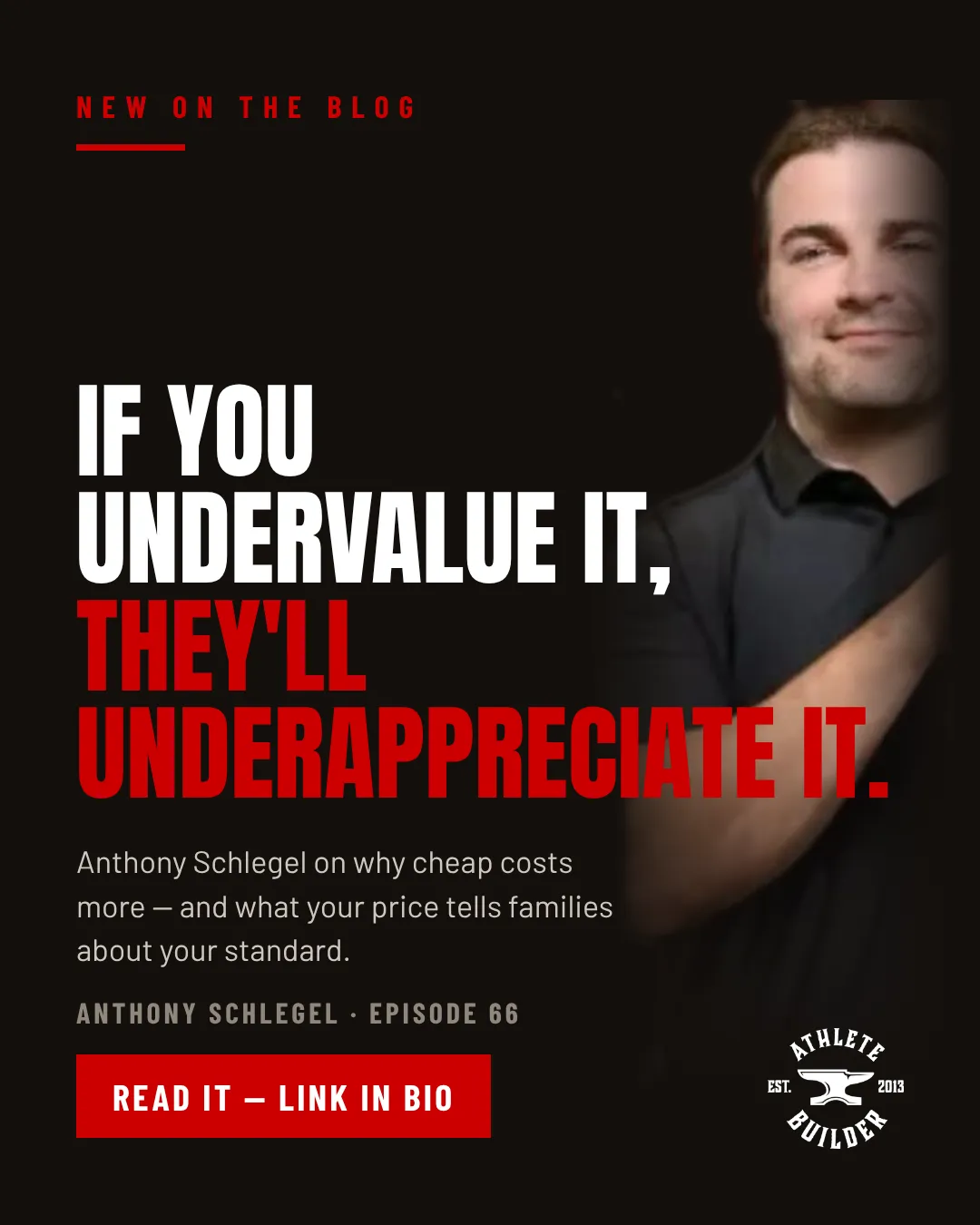
If You Undervalue It, They'll Underappreciate It
If You Undervalue It, They'll Underappreciate It
Anthony Schlegel has been on just about every side of a weight room. State champion wrestler. Air Force Academy, then Ohio State. Drafted by the Jets, played for the Bengals. Strength coach at Ohio State. Founder of The Difference, a patented striking machine he sells into college and NFL weight rooms. When we recorded, he was running the business side of The Armory in Columbus as executive vice president.
So when a guy with that résumé says the thing he repeats most in business is about price, owners should lean in.
"The cheaper it is, the more it'll cost. That's a fact, right? The cheaper you price it out to be, the more cost is gonna be associated with it. And I also say this, if you undervalue it, they'll underappreciate it."
He says both of those, in his words, "in business all the time."
Free is the most expensive thing you sell
I told him a story from my own gym on that episode, because I'd just lived it.
I ran two clinics close together. The first one was free for members, on the big three lifts. "Attendance was poor," as I put it on the show. The second was a small clinic with a handful of targeted people, and I charged a nominal fee. On a percentage basis, attendance went "through the roof."
Same coach. Same building. The only thing that changed was whether people had something on the line.
I saw the same thing with consultations. I started asking for a $25 deposit to book one — refunded the minute the person walked in the door. On tape: "My show up rate is like 93%." When I just put people on the calendar for free, "My no show rate is over 50."
Twenty-five dollars didn't change anybody's finances. It changed their commitment. That's Schlegel's point. A low price isn't a gift to the family. It tells them how seriously to take you, and they believe it.
Price is a message about your standard
Schlegel ties pricing straight back to value: "pricing is critical in business. But also making sure that people appreciate the value that they're getting."
Then he adds the line every program owner should hear: "it all holds true when you're dealing with a program."
At The Armory he wrestled with this in real time. One flat price for everything undersold what was in the building. So they moved to a base membership with services added on top, "because you have skin in the game, which is what you want."
He was honest that the hard part isn't the price. It's explaining what people are getting. "The value proposition of the armory is so massive. How can you articulate that to the consumer?" he said. "That's our hardest thing right now."
That's the owner's real job. If a parent can't see what their athlete gets from you that they can't get from a cheaper option, you don't have a pricing problem. You have a value problem that shows up as a pricing problem, and the conversation turns to price, and you lose it.
The standard is the standard
Pricing is one kind of standard. Schlegel's other stories were about the kind you enforce on the floor.
At Ohio State, he said, the rule was simple: check in with the nutritionist 30 minutes before the workout, or you're late. High-profile players who showed up one minute late got the consequence like anybody else, and made it up on Saturday. No exceptions for status.
"The standard is the standard, regardless of who you are," he said. "And again, when you do that, it permeates throughout the program that nobody's above anything."
The point for an owner isn't the punishment. It's what happens when the standard holds. People trust it. Families trust a facility whose rules don't bend for the best athlete or the biggest check, the same way they trust a price that doesn't bend because someone pushed back.
Discount your price and you've told the market your price was negotiable. Bend your standard for one athlete and you've told the whole room the standard was negotiable.
When your heart sets the price
Before we even started recording, Schlegel and I were talking shop about the business side, and I admitted something on tape I'd tell any owner: "I've made decisions where my heart was winning over my head. And in every one of those, I've lost."
For a coach, the heart decision usually looks like generosity. You knock the price down for a family you like. You run the clinic free because you want the kids in the room. You don't charge for the extra session because it feels wrong to bill for something you love doing.
Every one of those feels right in the moment. Every one of them teaches the family that what you do is worth less than you charge.
Schlegel's version of the trade-off was honest too. Building something of your own buys freedom, but not for free. "We have worked harder to have more autonomy. But with the autonomy has come more work to allow us to have autonomy."
That's the deal every owner signs. If you're going to carry that load, the work has to be priced like it matters, because it does. Charging what it's worth isn't the opposite of caring about the athlete. It's how you stay in business long enough to keep caring about the next one.
Don't confuse activity with achievement
One more thing Schlegel said, and it's the one I needed to hear.
"Don't confuse activity with achievement."
He was talking about himself. Multiple businesses, a podcast, a family, his faith, constant travel. His honest read: "I know I can only be elite at five things. Like I can't be elite at more than that."
Running a facility, it's easy to say yes to everything. Another class time. Another program. Another discount to fill a slot. That's activity. Achievement is a short list of things done at a standard high enough that people pay full price for it and tell their friends.
Now what?
Three questions for your next staff meeting:
1. What are you giving away for free that people would value more if it cost something — even a refundable deposit?
2. Can a parent explain, in one sentence, what their athlete gets from you that they can't get somewhere cheaper?
3. Which standard in your building quietly bends for the right athlete?
If those answers bother you, that's worth a conversation.Book a Game Plan Sessionand bring your numbers.
And if you want to see where one of your own athletes stands across all six blocks — Mindset, Knowledge, Teammates, Training, Nutrition, Recovery — thefree Athlete Builder Assessmenttakes 8–12 minutes.
Win the Day. Stay Relentless.
— Jim Beebe
Watch the full conversation with Anthony Schlegel — Episode 66: https://youtu.be/JDrnSLDJ0mo
317-224-6960