
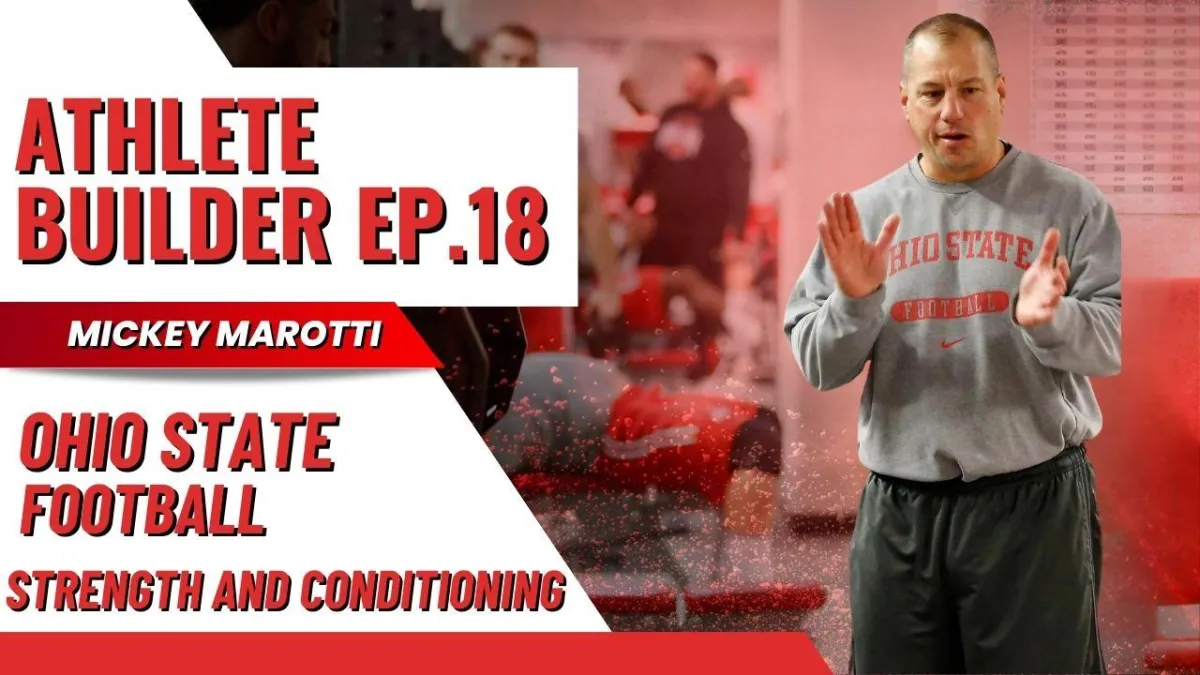
What Ohio State's Strength Chief Says Athletes Are Missing
What Ohio State's Strength Chief Says Athletes Are Missing
Mickey Marotti has spent 37 years building athletes. Three national titles. More than 50 first-team All-Americans. Over 30 first-round draft picks — roughly one a year for three decades. Today he oversees sports performance for 39 teams and 1,100 athletes at Ohio State.
When I sat down with him on the Athlete Builder podcast, I expected to talk about training champions. We did. But the conversation kept returning to something else — a warning, really, aimed straight at young athletes and the parents raising them.
The kids showing up to college sports have more skill reps than any generation in history — and many of them are arriving physically unprepared to use them.
The separator moved, and most families didn't notice
Here's how I framed it for Mickey, from years of coaching junior high, high school, and college athletes:
When we were kids, you played rec ball, and if you were good, you got a few extra weeks of travel all-stars at the end of the season. Those extra reps were the separator — the kids who got them went further.
Now almost every serious kid plays travel sports year-round. The extra reps aren't the separator anymore. They're the standard. The new separator is what's underneath: are you strong enough, powerful enough, durable enough to handle all that volume?
Mickey's answer:“Yeah, 100%. And you see it more and more and more.”He described kids flying across the country for seven-on-seven — half a day of travel, a full day of competition, back on a plane, back to school. “There isn't time to train in terms of strength training,” he said. “I'm very concerned. I don't know how we fix that.”
Sit with that for a second. The man who builds Ohio State's athletes — with a 22-person staff and one of the world's top sports scientists, Dr. William Kraemer, as senior advisor — looked at how young athletes are developing and said he's very concerned. Their own survey of incoming freshmen's exposure to strength and speed training at the high school level? His words: “Very concerning.”
The kid with elite skill training — and half a gym unused
Mickey told a story that should land with every sports parent paying for private training. One of his defensive backs trained at a high-end facility out west — turf on one side, weight room on the other, skill coaching from former NFL players. Elite reps, real coaching, real money. And Mickey's review when the kid arrived on campus:“Great skill work... you forgot to go on the other side of the gym.”
The lunges, the squats, the strength foundation — undone. Not because the family didn't invest. Because nobody diagnosed what was actually missing. The skill work was visible and impressive. The gap was invisible — until it wasn't.
That's the pattern I see constantly with the athletes I coach: the work isn't random because kids are lazy. It's random because nobody has shown the family a full picture of the athlete — what's strong, what's missing, and what to attack first.
Why the stakes are higher than they used to be
At the college level, the margin for catching up is disappearing. “Because of the transfer portal, if they're behind physically, they're going to be behind — they're just going to be,” Mickey said. Development windows that used to stretch across two or three college years are gone.“The sense of urgency is sped up. The problem is, you can't speed up physical development. There has to be slow, progressive overload.”
Read those two sentences together, because they're the whole story: the timeline got shorter, and the biology didn't. You can't cram strength the summer before college any more than you can cram a 500-pound squat before you can squat the bar. Which means the work has to start earlier — in the junior high and high school years most families spend chasing more games, more showcases, more reps of the thing their athlete is already good at.
And the cost of skipping it isn't just playing time. Coaches at every level are watching under-prepared athletes absorb college-sized volumes in teenage bodies. Durability is a trainable quality — the best ability is availability, and it's built the same slow way strength is.
Clarity of purpose — the mindset piece that makes the work stick
One more thing from the conversation, because Ohio State doesn't only build bodies. Mickey's staff has studied military training extensively, and the phrase he kept coming back to wasclarity of purpose: “knowing exactly what the mission is, exactly what you're supposed to do... clear, clean, and concise.” When an athlete has it, everything gets easier. “When there's confusion, there's hesitation,” he said — and a confused athlete can't fully buy in.
That applies to an 11th grader as much as a Buckeye. An athlete who knows exactly what to attack — this block, this habit, this month — works differently than one who's just... working. Effort without a target is how families end up busy and stuck at the same time.
What a parent can actually do with this
You don't need Ohio State's staff to act on Mickey's warning. You need what his athletes get on day one: an honest diagnosis. Here's the move:
1. Get the full picture.Skill is one block. Champions are built across six — mindset, knowledge, teammates, training, nutrition, recovery. Most young athletes have never been scored on any of them.
2. Find the weak link.One block is quietly holding the others back. For the travel-ball generation, it's often the physical foundation — but not always. You don't know until you measure.
3. Attack one thing.Clarity of purpose, kid-sized: one target, a few daily habits, measured again in 90 days. That's how development actually compounds — inch by inch, on a timeline biology respects.
That's exactly what the freeAthlete Builder Scorecarddoes. Fifteen minutes. Your athlete gets scored across all six blocks and walks away knowing their first target — the same starting point I'd give any athlete who walked into my gym.Take it free at athlete-builder.com/assessmenttest.
And if you want the full Marotti conversation — the mat drills, the traditions, all 37 years of it — the complete episode is below. It's worth every minute.
[EMBED: Full Mickey Marotti episode — https://youtu.be/TV1ZTyru5M4]
Win the Day. Stay Relentless.
— Jim Beebe · Founder, Athlete Builder · Author ofAthlete Builder: The Blueprint to Build Champion Athletes
317-224-6960